
Key Takeaways
- No industry-wide durability standard exists for dog toys, so words like "tough" are marketing, not measurement.
- A defensible rating uses three tiers — light, medium, power — defined by dog weight class and chew behavior, not by material alone.
- Tiers only mean something when tied to bench tests: torsion, pull, drop cycles and mass loss, run the same way every time.
- Marketplace-safe wording describes the dog the toy is built for; "indestructible" invites takedowns and falsifying videos.
- Put the tier, its test protocol and the AQL level into the purchase order, so the rating survives supplier changes.
Open three supplier catalogs side by side and count how many toys claim to be tough, durable or built for aggressive chewers. Then look for a definition of any of those words. You will not find one, because the pet toy industry has never agreed on what a bite strength rating is. One factory's "durable" toy survives a German Shepherd for a year; another's dies in an afternoon — and both catalogs say the same thing.
For a buyer, that vacuum is not an abstraction. It becomes returns, refunds and one-star reviews that describe the same scene: a toy destroyed faster than the listing promised. This article sets out how a supplier should rate and label durability instead — a tier framework tied to dog weight and chew style, the bench tests that give each tier meaning, and wording that survives platform review.
Why "Indestructible" Is a Labeling Vacuum
A purpose-built pet toy standard exists: ASTM F2999 covers material hazards, sharp edges and squeaker attachment for pet toys. What it does not do is grade service life. No major market publishes a bite-strength scale that a toy must pass before it can be called durable, and no trade body maintains one. The vacuum runs downhill. Factories mold whatever hardness the sample room approved once; importers copy whichever adjective the competitor used; marketplace listings escalate toward "indestructible" and "unbreakable" — claims that are unprovable by design and increasingly targeted by platform policies on exaggerated claims.
The cost lands in the review section. Across chew-toy categories, the most common negative review describes destruction, and the most common seller defense is that the dog was unusually strong. Both parties are describing the same failure: nobody ever defined what the product was rated to withstand.
A Three-Tier Framework Buyers Can Defend
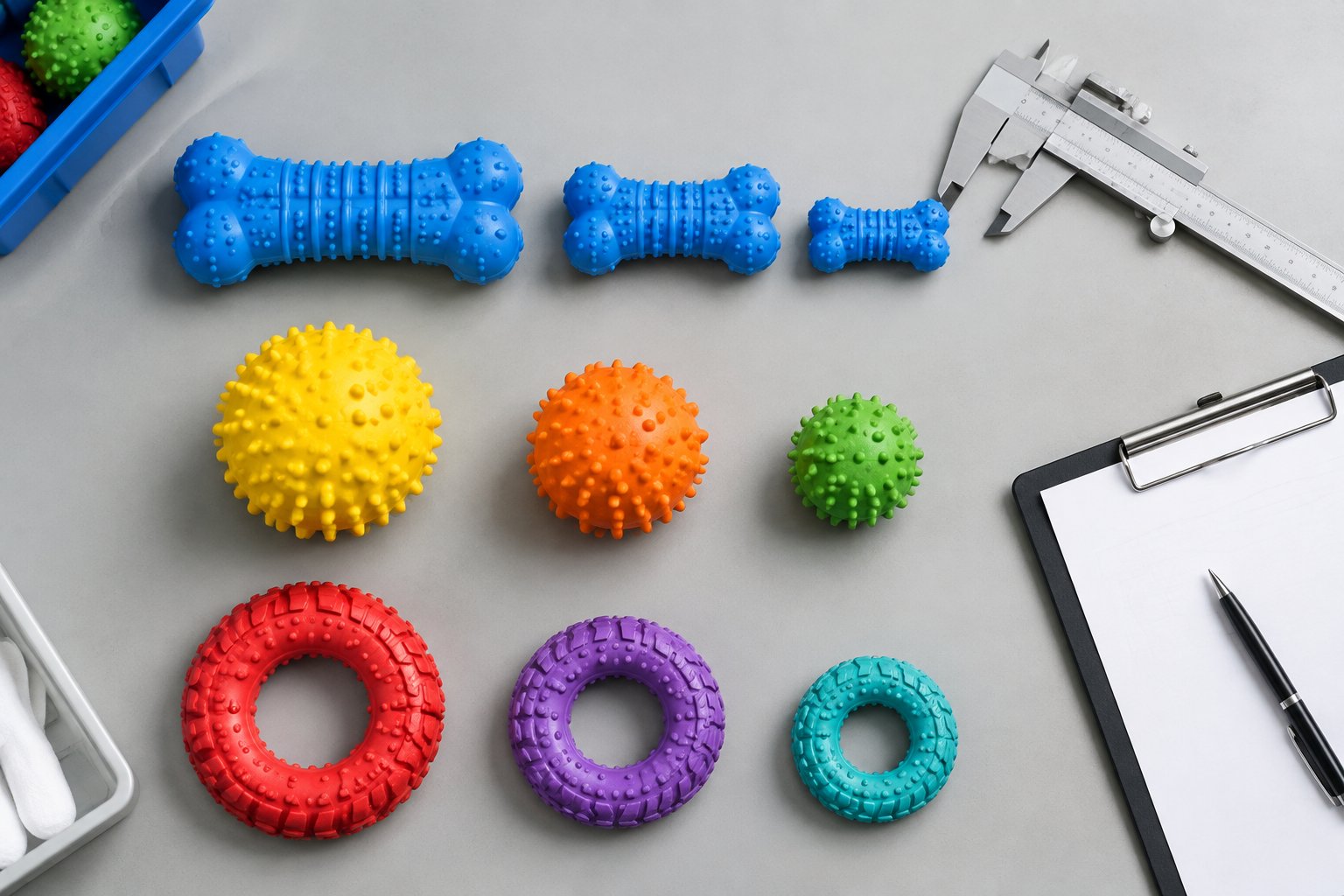
Until a real standard arrives, the practical answer is a self-declared but consistently applied rating built on two axes: the dog's weight class and the chewing behavior the toy was engineered for. The system we run internally — and recommend to private label clients — uses three tiers:
| Tier | Dog profile | Behavior assumed | Materials that typically hold | Listing wording that passes review |
|---|---|---|---|---|
| Light | Under 10 kg; puppies, seniors, gentle chewers | Mouthing, carrying, soft gnawing | Soft TPR, latex-feel vinyl, plush with reinforced seams | "For gentle chewers and cuddle time" |
| Medium | About 10–25 kg; average adult dogs | Regular chewing, tugging, fetching | Medium TPR, cotton rope, lined plush | "For moderate chewers — not for powerful jaws" |
| Power | Over 25 kg or determined destroyers | Sustained gnawing, prying, shredding | Vulcanized natural rubber, firm nylon, dense rope | "Built for power chewers; supervise and replace when worn" |
Notice what the framework refuses to do: promise a lifetime. A tier describes the dog and the behavior the toy was engineered around. Expectation management stays where it belongs — in the size chart and the supervision note.

From Label to Lab: Making Each Tier Measurable
A rating is defensible only if a test stands behind it. The exact thresholds can stay internal; what matters is that the same protocol runs every time a new mold, a new compound or a new supplier enters the range. A workable in-house battery:
- Torsion and tensile pull to failure on the weakest axis, recorded per material batch.
- Cyclic compression that mimics repeated bites, counting cycles to first visible crack.
- Drop and throw cycles onto a hard surface from realistic heights, for fetch and retrieve shapes.
- Mass loss after a fixed chew simulation, used as a shredding index for plush and rope.
- Squeaker and attachment pull-off force, aligned with toy-standard pull test practice.
Calibrate the protocol against real dogs once: play-test each tier with known chewers, then adjust machine thresholds until lab results predict field results. After that calibration, a new SKU can be tiered in an afternoon — and the numbers behind the label are yours to show any retailer who asks.
Wording That Survives Marketplace Review
Marketplaces increasingly police exaggerated product claims, and "indestructible" is the classic trigger. The safer pattern describes fit instead of invincibility. Compare "indestructible dog toy" — a claim any large dog can falsify on camera — with "designed for power chewers over 25 kg; replace when worn," which is a statement of intent your tier framework can back. The second sets expectations you can actually meet, and meeting expectations is what actually reduces return rates.
Two supporting habits keep listings safe. First, pair every durability tier with a size recommendation, because most destruction complaints trace to undersized toys rather than weak materials — a point worth building into your listing structure from the start. Second, keep the supervision note visible. No chew toy is a permanent object; listings that say so age better than listings that pretend otherwise, and review readers reward the honesty with fewer destruction complaints.
Writing the Rating Into the Purchase Order
A rating that lives only in a catalog is marketing. A rating that lives in the purchase order is a specification — which matters the day you switch factories or add a second supplier for the same SKU. Four clauses make it real:
- The tier (light / medium / power) printed on the SKU spec sheet and the retail hangtag.
- The bench tests behind the tier, with pass thresholds and a retained golden sample as the reference.
- AQL 0 / 2.5 / 4.0 shipment inspection, with durability-critical defects — open seams, loose squeakers, premature cracks — classified as major.
- Re-test triggers: any compound, mold or supplier change restarts tier testing before shipment.
Suppliers who already run durability programs — the ones who publish their QC criteria — accept these clauses without friction. Resistance is informative in the other direction: if a factory cannot name the test behind a durability claim, the claim rests on nothing, and you now know before the first container ships rather than after.
Frequently Asked Questions
Is there an official bite strength rating standard for dog toys?
How should I choose a durability tier for my customers?
What durability wording is safe on Amazon and other marketplaces?
How do I verify a supplier's durability claims before ordering?
Building a tiered chew-toy range?
Send your dog-size segments and target tier — we reply with material options, the durability test plan behind each tier and FOB ranges by configuration.