
Key Takeaways
- Color in pet toys comes from masterbatch — a concentrated pigment blend — and that is where heavy metal risk concentrates too.
- Migration testing is the measure that matters: EN 71-3 simulates exposure to stomach acid and screens 19 elements across three material categories.
- Bright colors are not automatically unsafe; undocumented colors are. Judge colorants by paperwork, not by shade.
- For pet toys, toy-standard testing is voluntary and buyer-driven; what is mandatory in the EU is REACH and GPSR general product safety.
- Lock the masterbatch maker, grade and per-color screening into the PO — color quality drifts the moment nobody is watching.
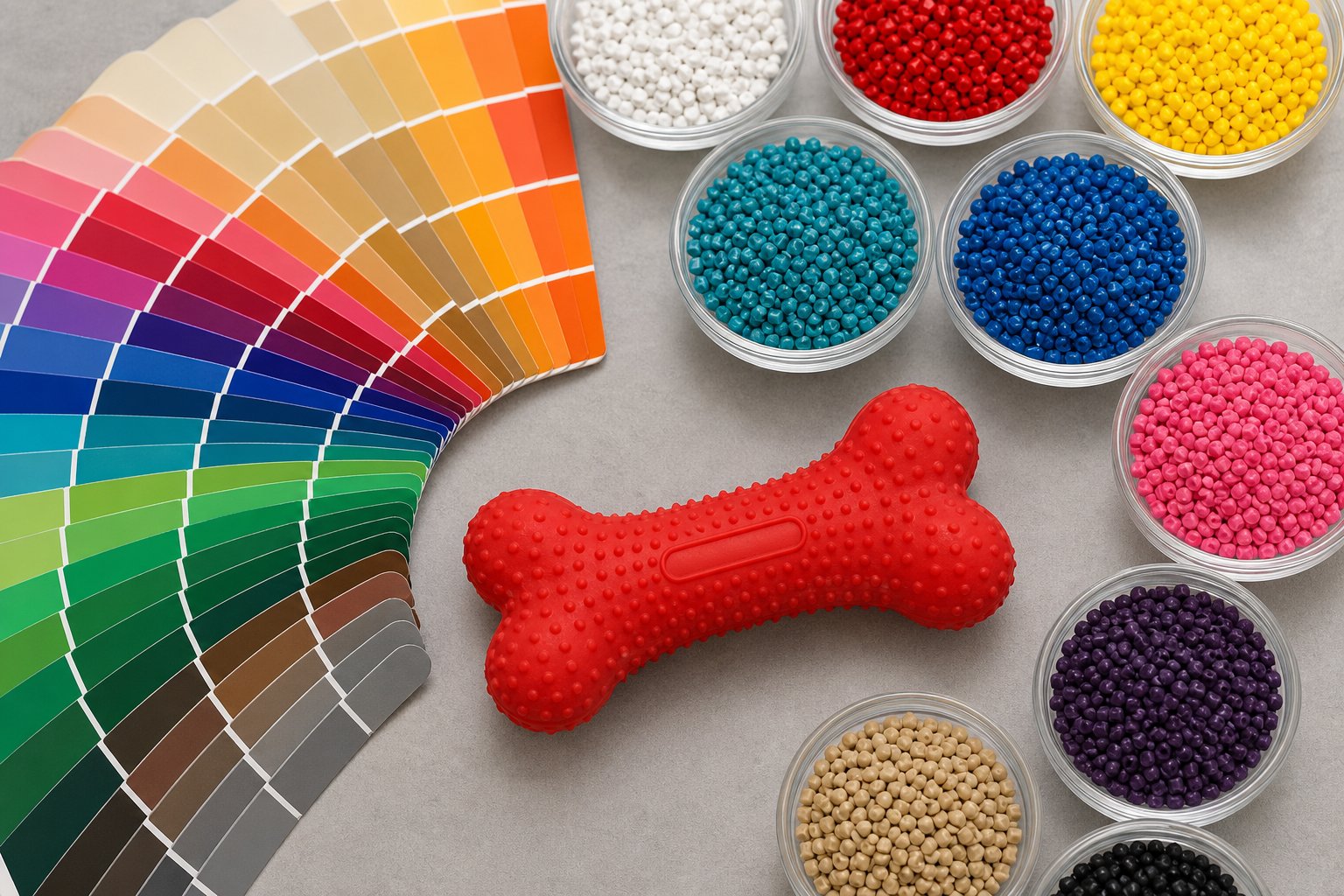
Every pet toy range has a hero color. A coral-red rubber ball, a turquoise squeaky crab, a sunshine-yellow tug bone — shades chosen in a buyer meeting because they photographed well. Almost nobody in that meeting asks where the color was made, which pigment chemistry sits inside it, or who would answer for it if a screening test found lead. The color is the product's loudest feature and, in sourcing terms, its least examined one.
This article follows the color backwards: from the finished toy to the masterbatch that carries it, to the migration tests that make a bright toy defensible in the EU, and to the purchase order clauses that keep color quality from drifting between reorders.
Where the Color Actually Comes From
Rubber and plastic toys are not colored by paint. They are colored by masterbatch: a carrier resin loaded with a high concentration of pigment, produced as pellets and dosed into the base material during mixing or molding at a low percentage. This is why color is a supply chain decision and not just an aesthetic one — the masterbatch maker, not the toy factory, usually controls what is inside the color.
Masterbatch is a commodity market with an enormous quality spread. At the top are makers serving food packaging and children's products, whose pigments are documented down to the metal content of the raw colorant. At the bottom are generic colorants blended from whatever feedstock is cheapest that week, sometimes including recovered material of unknown origin. Both are sold as "red." Only one of them arrives with a paper trail.
The Heavy Metal Question: What Actually Matters
The metals of concern in colored toys are lead, cadmium, mercury and their periodic-table neighbors — antimony, arsenic, barium, selenium among them. Historically, some of the most vivid yellow, orange and red pigments were built on lead and cadmium chemistry; modern formulations have moved away from that legacy, but low-cost and recovered colorants can still carry traces. A dog chewing a toy is doing something closer to digestion than to handling, which is exactly why the toy world measures migration rather than total content.
That is the logic of EN 71-3, the European toy standard for migration of 19 elements. The test simulates exposure to stomach acid and measures how much of each element can actually leach out of the material, with limits set per material category — scraped-off coatings, polymeric materials and the like. A metal that stays bound inside the pigment counts differently from a metal that comes out. For pet toys the standard is voluntary, buyer-driven practice rather than law, but it is the most common screen EU buyers request for colored parts, and the most sensible one to point to.

What Cheap Masterbatch Does to Your Product
The obvious risk is a failed screening test. The operational risks are quieter and cost more over a season. Recycled or generic carriers bring batch-to-batch color drift: your hero coral shifts toward salmon, the reorder no longer matches launch photography, and listing images start lying. Undocumented colorants can also bleed, chalk or fade under UV — failure modes that show up as reviews describing a "faded, boring" toy long before any laboratory gets involved.
| Color family | Where the risk historically sits | What a proper screen covers | Buyer action |
|---|---|---|---|
| Bright yellow, orange, red | Legacy lead and cadmium pigment chemistry; recovered feedstock | Full element migration screen on the colored part, not just the base resin | Named masterbatch grade plus per-color report |
| Deep blue, green, purple | Pigment loading pushed high to hit the shade cheaply | Migration plus rub-fastness so color does not transfer when slobbered | Color chip retained per batch |
| White, black, gray | Titanium dioxide or carbon black grades of unknown origin | Element screen; confirmation the grade is intended for consumer goods | Datasheet on file before sampling |
| Pastel tints | High carrier ratio; recycled carrier hides drift best | Carrier origin declaration and batch color retention | Virgin-carrier commitment in writing |
Read the table as a purchasing map: every color family has a characteristic way of going wrong, and every failure mode has a clause that closes it.
Locking Colorants Into the Purchase Order
Colorant quality is locked in writing or not at all. Four clauses do the work:
- Named masterbatch: the colorant maker and grade written into the SKU spec sheet, with a commitment that substitutions require your written approval.
- Per-color screening: a third-party migration report against EN 71-3 style limits for every color in the order, since each pigment formulation is its own risk.
- Color retention: a signed color chip per production batch, compared against the approved golden sample before packing.
- Re-test triggers: any masterbatch batch change restarts screening — the same discipline as a compound or mold change.
Factories with real material discipline hand these documents over routinely. When the paperwork arrives, read it critically — the five ways reports mislead are cataloged in our piece on test report red flags, and applicant mismatch is the most common one.
Reading a Colorant Report Like a Buyer
A useful migration report has four visible properties. The applicant matches your supplier or factory, not an unrelated trader. The sample description names the actual part — the red crab claw, not "rubber sample." The method cites a standard and a laboratory accreditation, and the date sits within the last 12 months. Anything else is decoration. If a supplier cannot produce that report, the fallback conversation is simple: test the colorants yourself before the first shipment, and deduct the cost from the price negotiation — or walk.
Bright color is worth fighting for; it is what makes a toy findable on a shelf and photogenic in a listing. The position worth holding is not "no color" but "no undocumented color." Our materials matrix lists the compliance notes we attach to every colored material we run, and we are happy to be benchmarked against them.
Frequently Asked Questions
Why do heavy metals show up in colored pet toys?
What does EN 71-3 actually test in pet toys?
Are bright colors automatically unsafe for dogs?
What should I ask a supplier for before ordering colored toys?
Sourcing a colorful range that survives screening?
Send your target shades and market — we reply with named masterbatch options, the test plan per color and FOB ranges by configuration.