
Key Takeaways
- Natural latex and vinyl make near-identical squeaky toys in photos but come from entirely different factories: dipping lines versus rotocast PVC lines.
- The push away from vinyl in Europe is commercial, not legal — retail PVC phase-out policies and phthalate screening expectations lead the way.
- Latex reads softer and calmer: matte surface, faint milky scent that fades, duller squeak — a positioning advantage for puppy and senior lines.
- Neither material is for power chewers; thin-wall construction sets the ceiling for both.
- Switching costs are real — new formers, slower craft labor, unit prices usually one FOB band above vinyl — so pilot on existing tooling first.
Across the last year of RFQs from European buyers, one request has quietly become routine: quote the squeaky line again, but in natural latex instead of vinyl. Sometimes the buyer names the trigger — a retail customer phasing PVC out of soft toy departments. Sometimes it is only a hunch that shelf expectations are moving. Either way, the switch is not a one-line substitution on a purchase order. Latex and vinyl look interchangeable in product photography, yet they come from entirely different factories.
Europe matters here for scale reasons alone. In Grand View Research's 2025 breakdown, Europe is the largest regional market for pet toys at roughly 35.6% of the global total — which is why what European retailers ask for tends to become every exporter's problem one season later. Understanding the switch is therefore useful even if you never ship to the EU.
Two Soft Materials, Made Two Different Ways
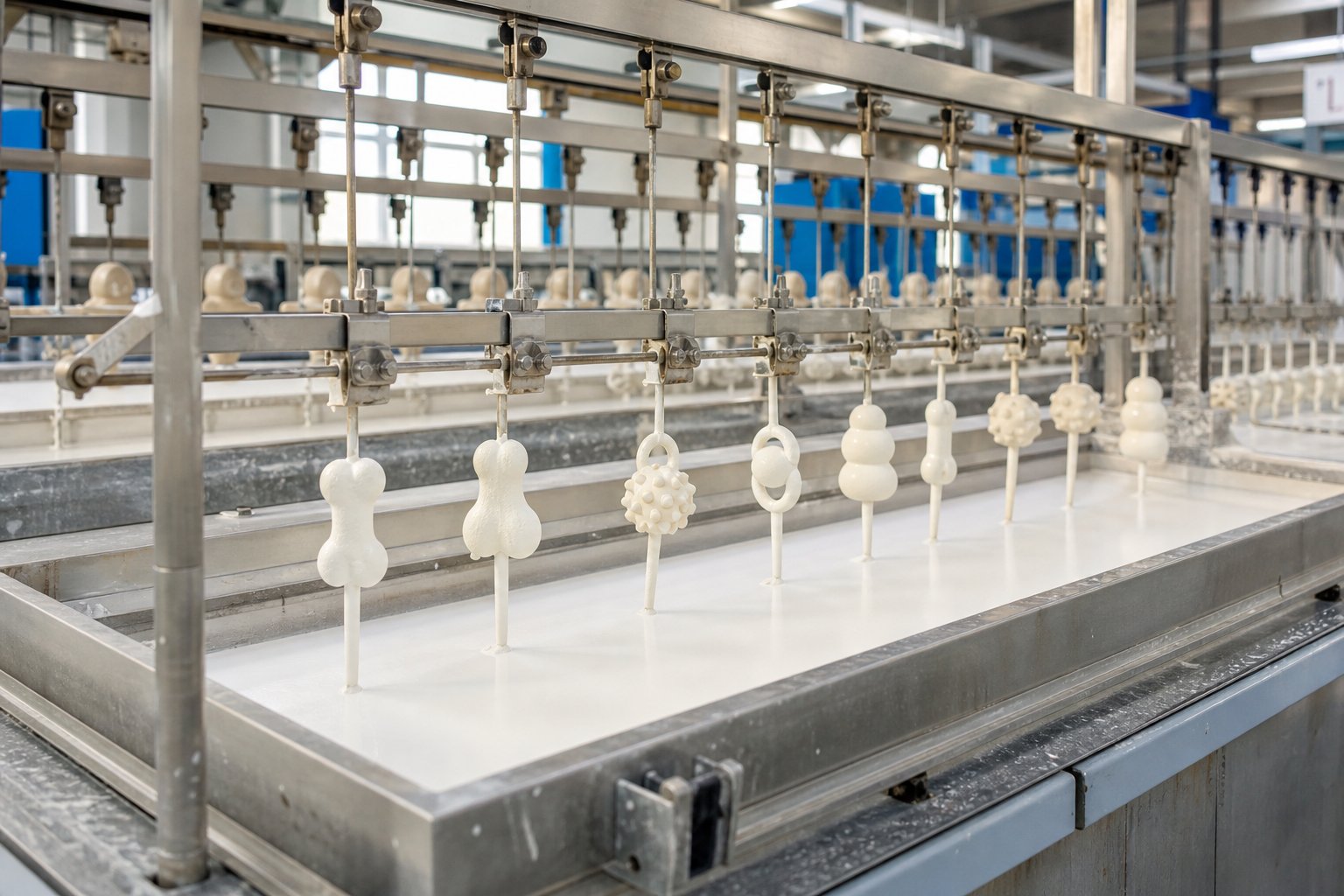
Natural latex starts as a liquid. Toy shells are produced by dipping ceramic or metal formers into natural rubber latex repeatedly, building up thin layers that are then vulcanized and stripped off by hand. Details are usually hand-painted. The result is a thin, elastic wall with a matte, slightly tacky surface and a soft, "gummy" bite that light chewers and puppies find easy to sink into.
Vinyl — rotocast PVC — starts as a paste. Liquid plastisol is poured into metal molds that rotate through ovens, gelling into a hollow shell with glossy color and crisp molded detail. Softness historically comes from phthalate plasticizers in the formulation, which is precisely where the regulatory conversation begins. Where latex walls spring back, vinyl walls are thinner-feeling but stiffer and less elastic.
The deeper point for buyers: the material decides the factory. A latex dipping line and a vinyl rotocast line are different investments, different skills and different QC habits. That is why "just switch the material" usually means changing production partners — a topic our factory and industrial-belt page covers from the capacity side.
What Actually Changes on the Shelf
| Attribute | Natural latex | Vinyl (rotocast PVC) | Why EU retail cares |
|---|---|---|---|
| Surface and feel | Matte, warm, slightly tacky grip | Glossy, slick | Tactile quality signals "natural" positioning |
| Scent out of the box | Faint milky smell that fades | Faint plasticky odor | Unboxing reviews mention it |
| Squeak character | Softer, duller tone | Brighter, sharper tone | Latex reads calmer in a living room |
| Detail and color | Hand-painted, artisanal variation | Molded detail, uniform color | Character traded against consistency |
| Plasticizer exposure | None — no PVC in the material | Phthalate-dependent softness | Vinyl carries the compliance file |
| Chew positioning | Light chew, puppy, senior | Light chew | Neither survives a determined power chewer |
The last row deserves emphasis because it is the honest boundary: both materials are thin-wall constructions. Swapping vinyl for latex buys you a better story and a softer feel — it does not buy durability. Whatever the material, wall thickness and the target dog's bite style decide survival, which is why our materials matrix lists bite-class positioning alongside every compound.
The Pressure Behind the Switch
Start with what is NOT happening: no European law requires pet toys to carry a CE mark or to comply with the children's Toy Directive — those instruments cover products for children. The forces reshaping the category are commercial. Large retailers are adopting PVC phase-out policies that cascade into pet departments. Buying teams screen soft plastics against phthalate benchmarks lifted from children's products — in practice, the CPSIA 8-phthalate set at 0.1% is the number that appears in RFQs, even though nothing compels it for pets. And consumers have learned to sniff: plasticky odor on unboxing is a recurring one-star theme.
Latex sidesteps most of this by chemistry: there is no PVC and no phthalate plasticizer in a natural latex toy. Buyers still ask for paperwork — a recent third-party screening report covering the compound and surface coatings, and voluntary toy-standard testing such as EN 71 for mechanical and chemical safety, which remains market practice rather than law. The pet-toy-specific route, verification against ASTM F2999, works for latex and vinyl alike. Our deeper dive on plasticizers explains the phthalate file in detail.
The Cost Logic of a Latex Line
Latex looks artisanal because it is. Multiple dips per shell, hand stripping, hand painting and slower vulcanization all add labor that rotocast vinyl never pays. Formers are cheaper than deep steel molds, which softens the tooling side, but the unit-price curve bends upward: in our quotes, a same-size latex squeaky toy typically lands one FOB band above its vinyl equivalent, with the gap widest on heavily hand-painted designs. Buyers should also expect natural-material batch variation — slight shade and scent differences between lots — and handle it the professional way, with a sealed golden sample and a sensory protocol at inspection rather than a hope that every batch looks identical.
Volume economics matter too. Because craft labor dominates cost, latex rewards SKUs that sell steadily rather than ones that spike; it is a poor match for deep-discount promotional packs and a good match for brand-led ranges where the natural story supports margin.
Switching Without Surprises: A Buyer's Checklist
Teams that switch cleanly tend to run the same sequence:
- Segment the range first. Move hero SKUs with a "natural" story; keep pure price SKUs in vinyl until the retail policy actually demands otherwise.
- Pilot on a supplier's existing toy forms before commissioning custom formers — you validate scent, squeak and hand feel without new tooling risk.
- Put wall thickness and light-chew positioning in writing, so the range is not marketed into durability claims it cannot keep.
- For SKUs that stay vinyl, demand a current 8P phthalate screening and review plasticizer options — alternatives exist at a cost, as our phthalate guide details.
- Agree a sensory odor protocol for both materials — unboxed, rubbed and bagged readings against a sealed reference.
- Check paint and print fastness to saliva and rubbing; hand-painted latex fails here first when it fails.
Run this way, a vinyl-to-latex transition becomes a merchandising decision with numbers attached, not a gamble on a material you last touched as a consumer.

Frequently Asked Questions
Are natural latex dog toys safe?
Why are European buyers moving away from vinyl pet toys?
Is latex more durable than vinyl for chew toys?
What does switching a line from vinyl to latex cost?
Rethinking a squeaky line for European shelves?
Tell us which SKUs you are weighing — we quote latex and vinyl side by side with FOB ranges, lead times and the documents each route needs.