Key Takeaways
- Dental claims are health claims, and health claims carry a burden of proof most chew toy listings cannot meet.
- What textured surfaces honestly do: mechanical abrasion while chewing and saliva stimulation that helps limit buildup between cleanings.
- Treats, prevents, removes tartar and veterinary recommended are the trigger words; mechanism wording passes where outcome wording fails.
- Claims hold up only when the texture geometry supports them — ridges where teeth actually land, in a material with enough give to wipe.
- Every dental claim should carry its own limits: not a replacement for brushing or professional veterinary dental care.
The notice usually arrives without much explanation: the listing for a textured rubber bone has been removed, and somewhere in the reason column stands a phrase like "unsubstantiated health claim." The product itself was fine. The sentence on the detail page — removes plaque and tartar fast — was not. Between a toy that helps and a toy that gets delisted sits nothing but wording, and most sellers meet this wall for the first time after the takedown rather than before it.
Dental positioning is worth having: it is one of the few purchase motivations in chew toys that owners treat as necessity rather than indulgence. This article maps the territory — what chewing on a textured surface actually does, which words fail and which pass, and how to design the product so the words you keep are true.
Why Dental Claims Get Flagged
Dental health sits inside the regulated space of health claims. Advertising rules in most markets restrict claims that a consumer product treats, prevents or cures a condition, and marketplaces apply their own stricter overlay: a listing implying a clinical outcome must be able to substantiate it, and a chew toy cannot. The enforcement rarely arrives as a debate about the product. It arrives as a rule match on the words — which is why two listings with identical toys can have entirely different fates.
The second pressure is comparative honesty. Dental disease in dogs is progressive and veterinary-managed; claims that a toy substitutes for professional care are not just unsubstantiated but potentially harmful, since an owner who believes them may delay needed treatment. Platforms know this, veterinarians know this, and increasingly the reviewers know it too — "the listing implied this would fix his breath" is a recognizable one-star genre. The wording you choose is therefore also a customer service strategy.
What Textured Surfaces Actually Do
The honest mechanism is mechanical, and it is real. When a dog chews, the textured surface rubs against the tooth surfaces it can reach, scraping soft plaque before it hardens; the chewing action itself stimulates saliva, which buffers the acids that mineralize plaque into tartar. That is the entire honest claim: abrasion plus saliva, limited to the surfaces the toy can reach, dependent on the dog actually chewing with interest, and bounded by the fact that most buildup forms along the gumline, where few toys reach well.
What a textured toy cannot do matters just as much. It cannot remove established tartar, which is calcified and needs professional scaling. It cannot reach below the gumline, where periodontal disease lives. It cannot compensate for a dog that does not chew, and it cannot deliver any result within a claimed timeframe, because chewing intensity varies too much between animals. A listing that respects those four limits can keep its dental section permanently; a listing that crosses any of them is renting space until an algorithm or a competitor notices.
A Claim Library That Passes Review
The pattern that survives enforcement is mechanism-first wording: describe what the toy is designed to do while the dog chews, never what outcome the dog's mouth will reach. The comparison below is the one we hand to clients writing listings:
| High-risk wording | Why it fails | Defensible alternative |
|---|---|---|
| "Removes plaque and tartar" | Outcome claim; tartar removal requires scaling | "Ridges scrub teeth as your dog chews" |
| "Prevents dental disease" | Prevention is a regulated health claim | "Supports chewing between brushings" |
| "Cures bad breath in days" | Cure plus timeframe; doubly flagged | "Chewing helps freshen breath naturally" |
| "Veterinary recommended" | Requires documentation almost no seller holds | "Designed with gum-massage texture" |
| "Replaces brushing" | Substitution claim; potentially harmful | "Not a replacement for brushing or vet dental care" |
Two habits complete the library. Keep the limit sentence — "not a replacement for brushing or professional dental care" — permanently in the listing; platforms read it as diligence, and owners read it as honesty. And never let imagery make the claim the copy avoided: a before-and-after tartar photo says "removes tartar" more loudly than any sentence.
Design Choices That Support Honest Claims
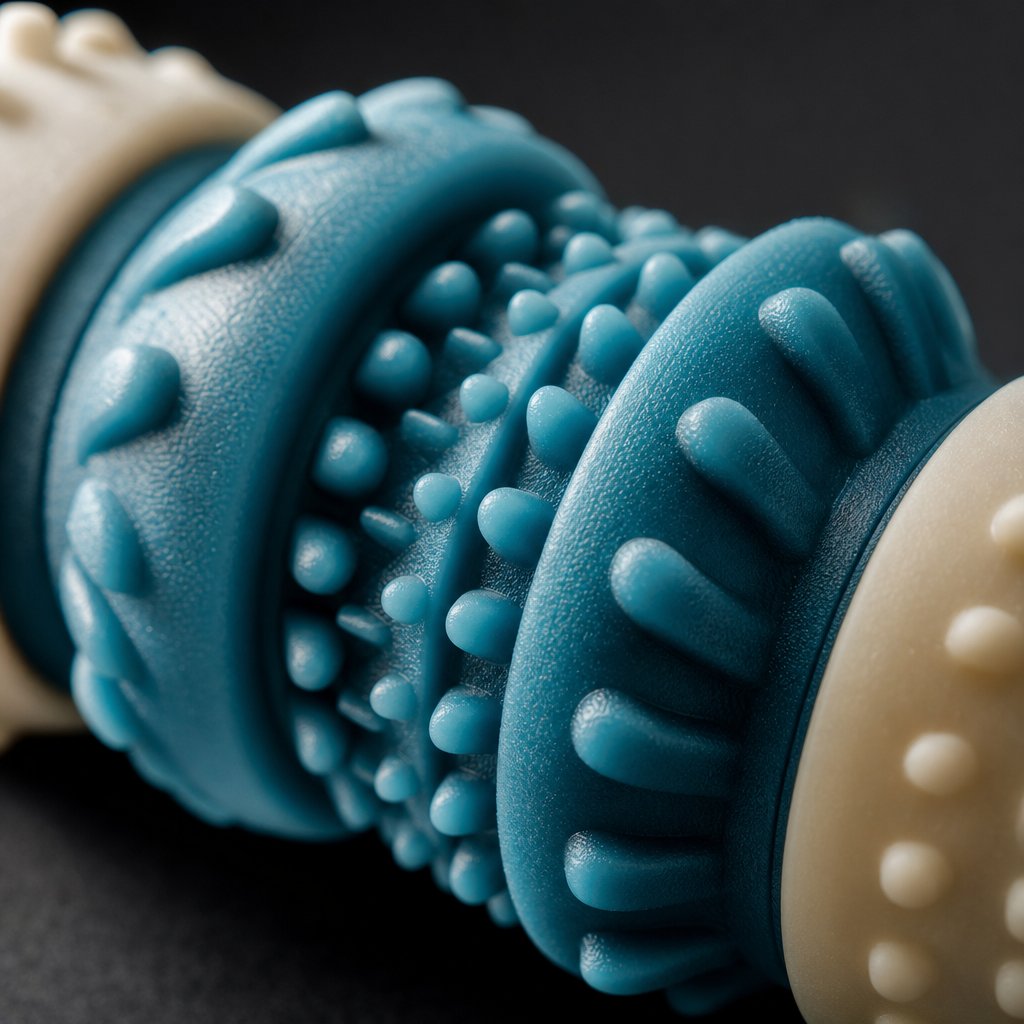
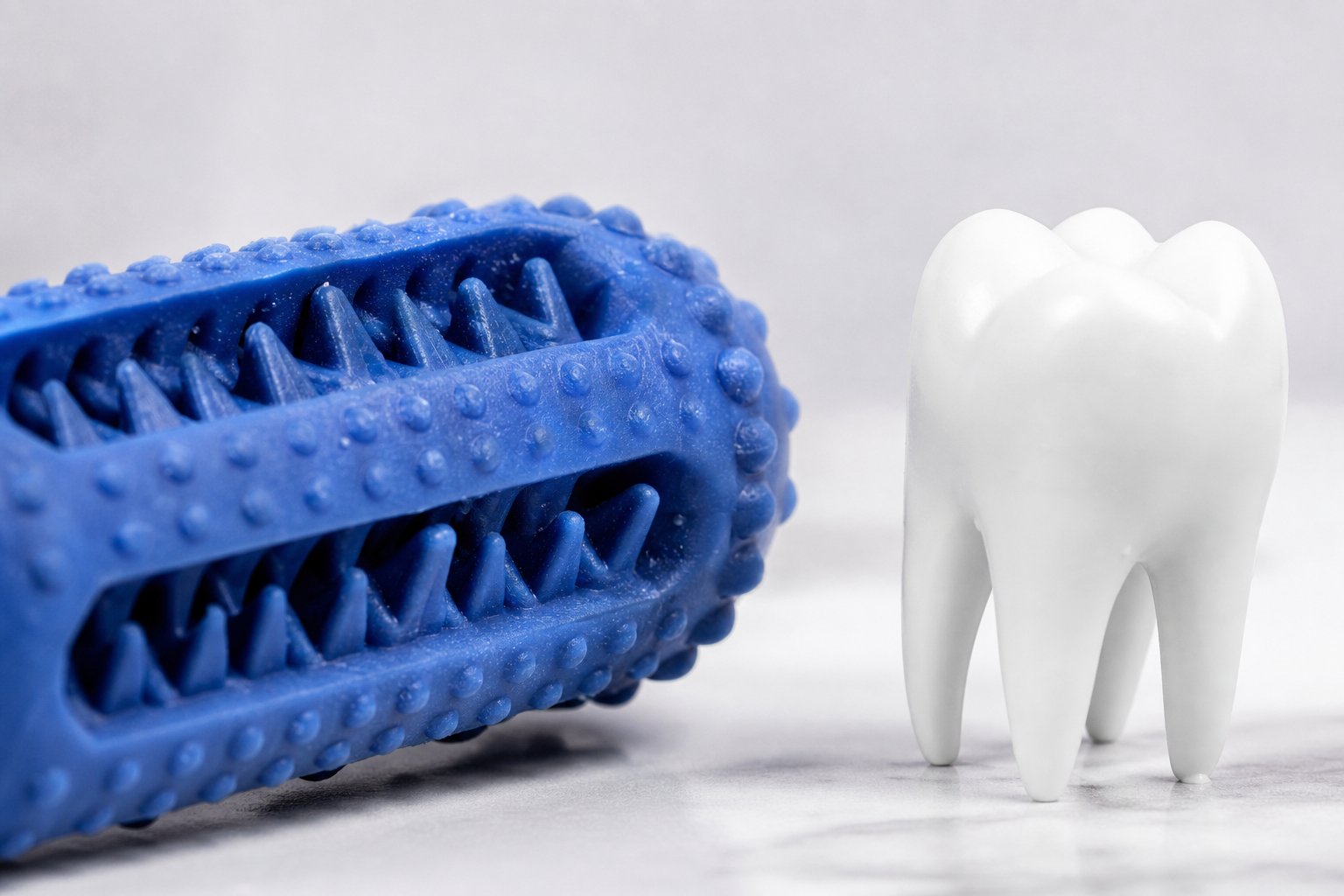
A mechanism claim is only as good as the geometry behind it. Ridges belong where teeth actually land during a natural chew — wrapping the surfaces a dog braces with its molars, not decorating the handle end. Texture depth needs a middle setting: shallow enough not to abrade gums, deep enough to still work after months of wear, and radiused so worn nubs never turn into blades. Material give matters as much as shape; a surface soft enough to conform slightly wipes soft plaque better than a hard one that skates over it, which is why most credible dental-style toys run medium-hard rubber or TPR rather than firm nylon.
- Ridge placement: map tooth-contact zones from real chewing postures, then put texture there and nowhere cosmetic.
- Hold-ability: shapes the dog steadies with its paws produce longer, more consistent chew sessions — and more abrasion.
- Wear behavior: texture must blunt, not sharpen; specify edge radii in the mold spec, not just in the drawing.
- Cleanability: deep grooves trap slobber and debris; draft angles that rinse clean keep the toy in rotation.
Design-for-safety rules still apply on top — small parts discipline, material compliance, the works — and our materials matrix records which compounds we run for dental-style textures. The visual burden falls on photography: a macro shot of ridges doing their job supports the mechanism claim far better than a smiling dog ever will, a principle our listing walkthrough on compliance and conversion applies across categories.

Positioning Dental Toys in the Range
Dental positioning works hardest in specific places: the listing subtitle, the bullet that explains the texture, and the post-purchase email that sets expectations before the first review. It works worst as a standalone claim in the title, where algorithms and competitors read it most aggressively. In the product line, dental-style textures belong to the medium-chew tier — firm enough to scrub, compliant enough to wipe — while power-chewer SKUs lean on durability language instead. Review management closes the loop: when a buyer mentions fresher breath or cleaner teeth in a review, that is the claim proving itself in the field, a driver we analyze in our piece on what drives pet toy reviews.
Frequently Asked Questions
Can a dog toy legitimately claim to clean teeth?
Why do dental claims get listings and ads flagged?
What wording is safe for textured dental-style chew toys?
What product features support an honest dental claim?
Developing a dental-style chew line?
Send your market and target tier — we reply with texture and material options, claim-safe listing language and FOB ranges by configuration.