Key Takeaways
- Dropship sells flexibility — no inventory, per-parcel cost. Bulk import sells margin — lower unit cost, with cash and risk moved to your side of the table.
- The crossover is a calculable volume, not a feeling: build both all-in per-unit curves and find where they meet.
- Inventory risk is a cost line — expected deadstock and clearance discounting belong inside the bulk model, not in a footnote.
- Most brands that scale run both at once: dropship the long tail, bulk-import the proven winners.
- A layered MOQ — 200 units per stock design, 1,000 for OEM, 3,000 for ODM — makes the switch gradual instead of binary.
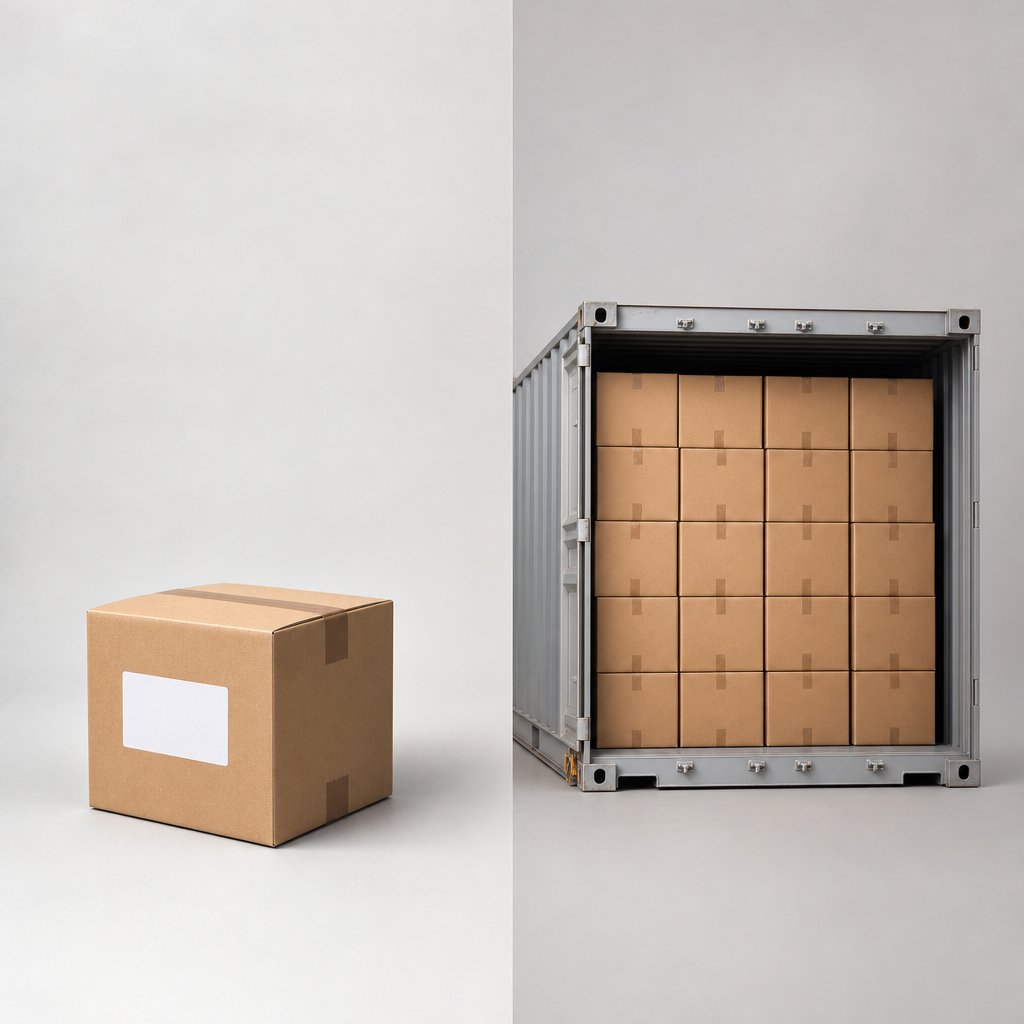
Every pet toy brand starts per-parcel. Dropshipping is how the first hundred orders ship without a warehouse, and it is the right answer at that stage. The failure mode is staying there: brands scale ad spend, volume climbs, and the per-parcel economics quietly become the largest controllable cost in the P&L. The sellers who compound are the ones who noticed the day the math flipped — because the crossover between dropshipping and bulk import is not a vibe, it is a number you can calculate for every SKU.
This article builds both cost structures side by side, shows how to locate your crossover point, prices the inventory risk buyers tend to hand-wave, and lists the signals that say a SKU is ready to move from the parcel line to the container line.
Two Models, Two Cost Structures
The models differ in where each cost lands. In dropshipping, the supplier's warehouse picks, packs and mails each order; you pay for that service inside a per-unit price, and pay nothing when nothing sells. In bulk import, you buy the goods at factory cost, pay freight and customs to move a consolidated volume, and operate the last mile yourself or through a fulfillment partner. Same toy, two different bills — and the difference compounds with every order:
| Dimension | Dropshipping | Bulk import |
|---|---|---|
| Unit goods cost | Highest — small quantities, service bundled in | Lowest — factory price at MOQ volume |
| Fulfillment cost | Per parcel, paid on every order | Bulk freight plus per-order pick and pack at destination |
| Cash profile | Pay per sale; working capital stays free | Cash out at PO; recovered over the sell-through cycle |
| Inventory risk | None — supplier holds stock | Yours: slow SKUs, seasonal misses, clearance |
| Branding control | Limited unless the program adds private label | Full: packaging, inserts, bundles, retail-ready boxes |
| Speed to first sale | Days | A quarter, door to door |
| Margin at scale | Capped by per-parcel economics | Improves with every consolidation |
Read the table vertically and each model looks rational; read it horizontally and you can see the trade — flexibility is bought with per-parcel cost, margin is bought with capital and risk. Neither column is wrong. The mistake is running one column after the other column has become correct.
Finding the Crossover Point
The crossover is the monthly volume at which the two all-in unit costs meet. Build both curves per SKU. The dropship curve is simple: goods price plus per-parcel fulfillment. The bulk curve has five layers: FOB price, freight and duty spread over the units, destination storage and handling, marketplace or 3PL fulfillment per order, and an expected-deadstock charge. An illustrative pair of curves for a mid-sized plush toy, using round numbers and labeled assumptions:
| Cost layer (assumption) | Dropship per unit | Bulk per unit |
|---|---|---|
| Goods (dropship program price vs FOB at 1,000 units) | 4.50 | 2.60 |
| International move (parcel vs consolidated sea + duty) | included above | 0.90 |
| Destination handling and storage | — | 0.60 |
| Marketplace pick, pack and ship | 6.00 | 4.20 |
| Expected deadstock (illustrative 10% at half value) | — | 0.13 |
| All-in per unit | 10.50 | 8.43 |
On these assumptions bulk wins by roughly two units of currency per sale — which is only true if the units actually sell. That condition turns the crossover from arithmetic into a judgment about velocity: compare the MOQ you would commit against monthly sell-through. A 200-unit stock buy against 60 units a month is about three months of cover, a normal bet. A 3,000-unit custom run against the same velocity is four years of cover, which no margin improvement justifies. The layered MOQ matters because it lets each winner step up at its own pace — and the mechanics of how unit prices really move with quantity are in our MOQ math article.

Inventory Risk, Actually Quantified
Buyers accept "inventory risk" as a word and then price it at zero. Put it in the model as two charges. The first is expected deadstock: the share of units that will not sell at full price in the season, times their recovery value — often half or less through clearance channels. The second is carrying: capital occupied, storage, and the option value of cash you cannot spend on the next winner while it sits. For toy categories with fast design turnover, the clearance haircut dominates. A bulk order that looks two units per unit cheaper on paper can be roughly break-even after a realistic deadstock charge — which is why the charge belongs in the base model, not the appendix.
The honest counterweight: dropshipping has a risk too. The supplier's stock is shared with other sellers, sync errors cause oversells, and per-parcel quality control is someone else's standard. Our dropship program exists precisely because those failure modes are operational, not theoretical — stock depth, same-day pick and ERP-level sync are the product.
The Signals That Say It Is Time to Switch
Crossovers announce themselves. When several of these are true for the same SKU, the parcel line is subsidizing it:
- The SKU has repeated as a top seller for three consecutive months, not one promotional spike.
- Monthly units have stabilized enough that a first bulk order is under about three months of cover.
- Fulfillment cost per order is now visible in the P&L — because you started listing it as its own line.
- Reviews mention packaging, or competitors' listings photograph better — branding control has become a conversion constraint.
- Cash flow can absorb one full buy-sell cycle on that SKU without touching operating funds.
- The supplier quotes a private-label tier — packaging and labeling at 200 units per design — so the switch does not require a full custom program.
The destination, for most brands, is not "bulk instead of dropship" but both: container-line economics for the proven twenty percent, parcel-line flexibility for the experiments still earning their data. When you do switch a SKU, rebuild its unit economics from scratch — the landed-cost structure differs enough that our landed-cost model is the right template.

Frequently Asked Questions
Is dropshipping pet toys profitable at all?
How do I calculate the crossover point between dropship and bulk?
What is the real inventory risk in bulk importing pet toys?
Can I start with bulk and still keep testing new toys?
Not sure which of your SKUs has crossed over?
Send your monthly volumes — we will map each winner against the 200-unit stock tier, the 1,000-unit OEM tier and the dropship line, with FOB ranges for all three.