
Key Takeaways
- "Eco" is not a material — it is a claim, and claims are only as strong as the document behind them.
- Three honest paths exist: renewable materials (natural rubber, certified wood), declared recycled content, and packaging choices.
- One claim, one document: material declarations, recycled-percentage statements and chain-of-custody IDs do the heavy lifting.
- Absolute wording — "chemical-free," "zero-waste," "100% natural" — is the fastest route to takedowns and consumer complaints.
- The premium attaches to specific claims for specific buyers: EU retail programs and material-transparent DTC brands pay; vague green words do not.
The fastest way to lose an eco-friendly listing is to be asked for evidence. A marketplace reviewer, a retail compliance desk or a competitor's lawyer picks one sentence — "100% natural and chemical-free" is a perennial favorite — and asks what it means. If the answer is a mood rather than a document, the claim comes down, and sometimes the listing with it. Eco positioning in pet toys is entirely buildable; it just has to be built out of materials and paper, not adjectives.
This guide maps the three practical paths to an eco claim, the evidence each one needs, the wording that survives scrutiny, and who actually pays for it — written for buyers assembling a line rather than decorating one.
Three Honest Paths to an Eco Claim
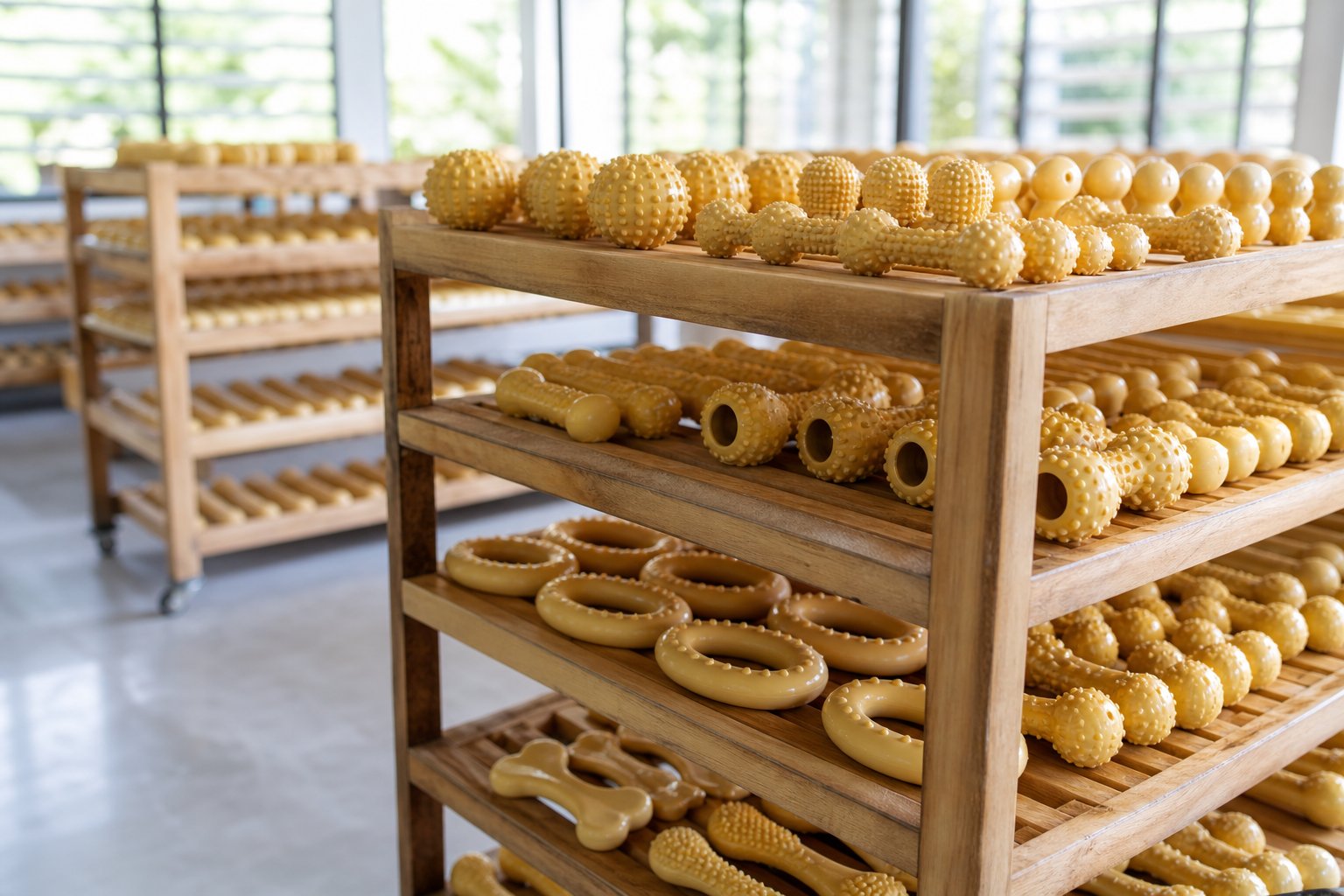
Path one: renewable materials. Natural rubber from plantation sources, wood and coffee-wood chews from managed forestry, cotton and sisal fibers — these support the cleanest sentence in the category: "made from natural rubber, a renewable material." The claim is about origin, and it is defensible because origin is verifiable. What it does not license is foot-printing you have not measured ("carbon neutral") or purity you cannot define ("chemical-free").
Path two: recycled content. Recycled polyester fill, reclaimed-fiber fabrics, regrind-reduced plastic parts — all claimable, all requiring a declared percentage and a supply-chain statement. This is the path where our plush and stuffing decisions do the talking: a declared recycled fill, honestly positioned at its tier, is worth more than an unlabeled premium. The trade-offs by fill type are covered in our plush internals guide.
Path three: packaging. The cheapest eco win in the category: mono-material wraps, recycled-content boxes, soy-ink hangtags, and the removal of mixed-material laminates that make packaging unrecyclable. Packaging claims are the easiest to evidence — you control the specification — and the first thing a retail sustainability desk checks.
| Path | Claim that survives | Evidence needed | Cost signal | Risk if unevidenced |
|---|---|---|---|---|
| Renewable material | "Made from natural rubber, a renewable material" | Material declaration; origin statement from supplier | Natural rubber quotes above commodity synthetics | Greenwashing accusations; retail delisting |
| Recycled content | "Filled with declared recycled polyester" | Stated percentage plus supply-chain declaration | Recycled fill can sit below or above virgin depending on grade | Claim withdrawal; platform takedown |
| Certified wood | "Wood from certified managed forestry" | Chain-of-custody certificate with identifier | Certified supply carries a visible premium | Certificate misuse claims |
| Packaging | "Recyclable mono-material packaging" | Material composition spec in your control | Usually cost-neutral to slightly positive | Low — but "biodegradable" without standards is not |
What Evidence Each Claim Actually Needs
Eco claims fail in the gap between the word and the file. The working discipline is one claim, one document, filed per SKU the way compliance documents are. Material declarations name the substance and origin. Recycled-content statements state a percentage and the stage of the chain it refers to — "recycled content" measured at the resin mill and at the finished toy are different numbers. Chain-of-custody certificates for wood carry identifiers a retailer can verify, which is precisely why they carry weight. And safety screens ride alongside rather than instead: recycled-content rubber, for instance, still needs PAH screening under REACH, and eco positioning never waives the general product-safety file for your market.
Note what is absent from this list: self-printed eco logos, "green" icons on hangtags, and factory brochures. None of them is evidence, and in front of a professional buyer they are anti-evidence — reasons to check the paperwork twice.
Wording That Survives Scrutiny
The wording boundary is narrower than most marketing teams assume, and the safe side is easy to state:
- Say the material, not the virtue — "natural rubber," "certified wood," "recycled polyester fill" beat "eco-friendly," "green" and "earth-loving" every time.
- Say the share, not "recycled" — a declared percentage reads as diligence; an unquantified "recycled" reads as decoration.
- Never the absolutes — "chemical-free," "zero-waste," "non-toxic by design," "zero formaldehyde": every one of these is either unprovable or false in the specific sense a reviewer will use.
- Biodegradable only with a standard — if you cannot name the standard and the conditions, say "recyclable" about packaging instead, where the claim is in your control.
- Safety stays separate — eco wording never substitutes for the safety tests your market expects; run both files in parallel.
Who Pays for Eco Lines — and How Much
The buyers who pay for eco positioning are specific. European retail programs increasingly carry supplier sustainability criteria, where a documented claim is the ticket to the shelf rather than a price premium in itself. DTC brands built on material transparency pay real premiums — typically one FOB band above conventional equivalents for comparable build — because the claim is their marketing engine. Marketplace-only sellers with generic eco wording get nothing for it: shoppers have learned to discount the word, and platforms have learned to question it.
The practical assembly for a range: natural rubber and certified-wood chews as the premium story, declared recycled fill in the plush tier where cost actually falls, and mono-material packaging across everything. That combination produces a range that reads coherent, survives scrutiny, and needs no adjective to sell.

Frequently Asked Questions
What makes a pet toy genuinely eco-friendly?
Is natural rubber better for the environment than synthetic rubber?
What evidence should back an eco claim on a listing?
Do eco-friendly pet toys sell at a premium?
Planning an eco line that survives its first compliance question?
Tell us the tier and market — we map materials, declarations and packaging to FOB ranges, with the document set each claim needs.