Key Takeaways
- A label is the only compliance document your customer actually reads. Treat it with the same rigor as a test report.
- US retail leans on origin marking and claim accuracy; EU retail leans on GPSR operator identity and local-language information; the UK mirrors much of the EU with its own twist.
- Care instructions are not law anywhere in this trade, but they are a retail expectation and a proven return-rate lever for plush.
- A base label plus market stickers works — if sticker application is treated as a controlled production step, not an afterthought.
- Version-control label artwork in the SKU compliance file; unlabeled or mislabeled stock is the cheapest defect to prevent and the most expensive to discover.
Of all the documents in a pet toy's compliance file, one gets read by millions and drafted by one intern in a hurry: the label. Buyers who would never accept a vague test report ship products whose hangtag names a company that no longer exists, in a market where nobody listed is reachable, with care advice the fabric cannot survive. Retail auditors read labels first for exactly this reason — the label is where your paperwork meets the physical world.
This article lays out what the three big retail regions actually expect on a pet toy label, how the elements differ, and how to run one label system across markets without turning pack-out into a lottery.
What Each Market Actually Expects
The table below is the practical map buyers use. Laws set the floor; retailer onboarding manuals add the rest:
| Label element | US | EU | UK |
|---|---|---|---|
| Country of origin | Required marking for imported goods | No general law for pet toys; claims must not mislead; retail expects it | Same posture as the EU in practice |
| Operator identity | Distributor address common in retail | GPSR practice: manufacturer contact plus an EU-established operator on the product or packaging | UK equivalent: a UK-reachable responsible entity is the onboarding norm |
| Product identification | SKU and batch by retail convention | Type, batch or serial expected under GPSR practice | Mirrors the EU approach |
| Language | English | Language(s) of the destination market for safety-related information | English |
| Care and use instructions | Retail expectation, not law | Retail expectation; supports the GPSR safety-information habit | Same as EU |
Three asymmetries are worth pausing on. The US origin rule is the hardest legal floor of the three. The EU operator-identity practice is the newest and the one most often missing from first-time EU shipments — our compliance dossier article shows where the responsible-person agreement lives in the file. And the UK, post-Brexit, behaves like the EU on identity but stands alone on its market-specific packaging schemes.
The Anatomy of a Retail-Ready Label
Pet toys carry labels in three physical layers, and each layer has a job:
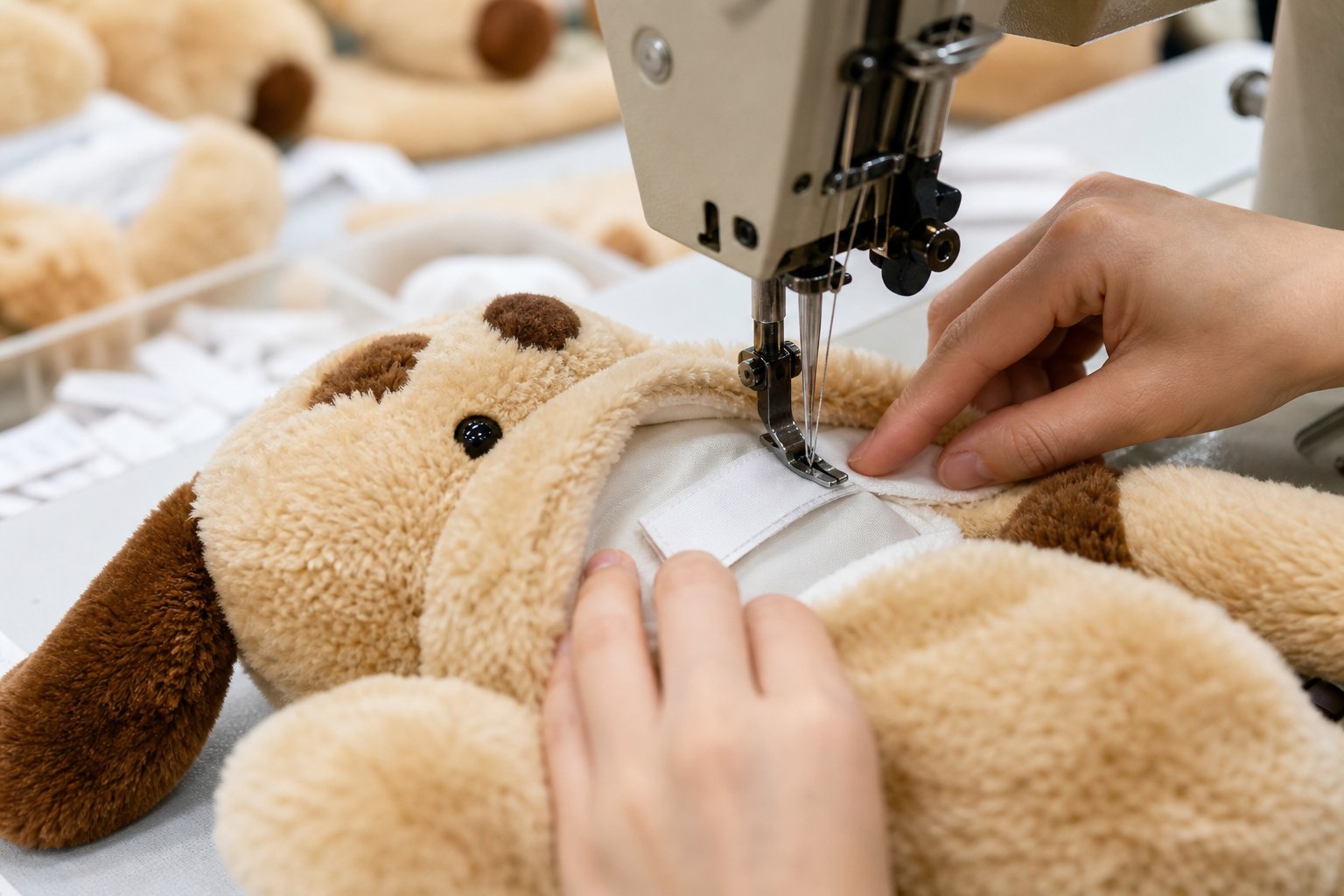
- The sewn-in or molded-in identity. For plush, a fabric label with origin and care survives the washing machine — the one place where the label outlives the packaging. For molded toys, embossed or printed material identity on the part itself.
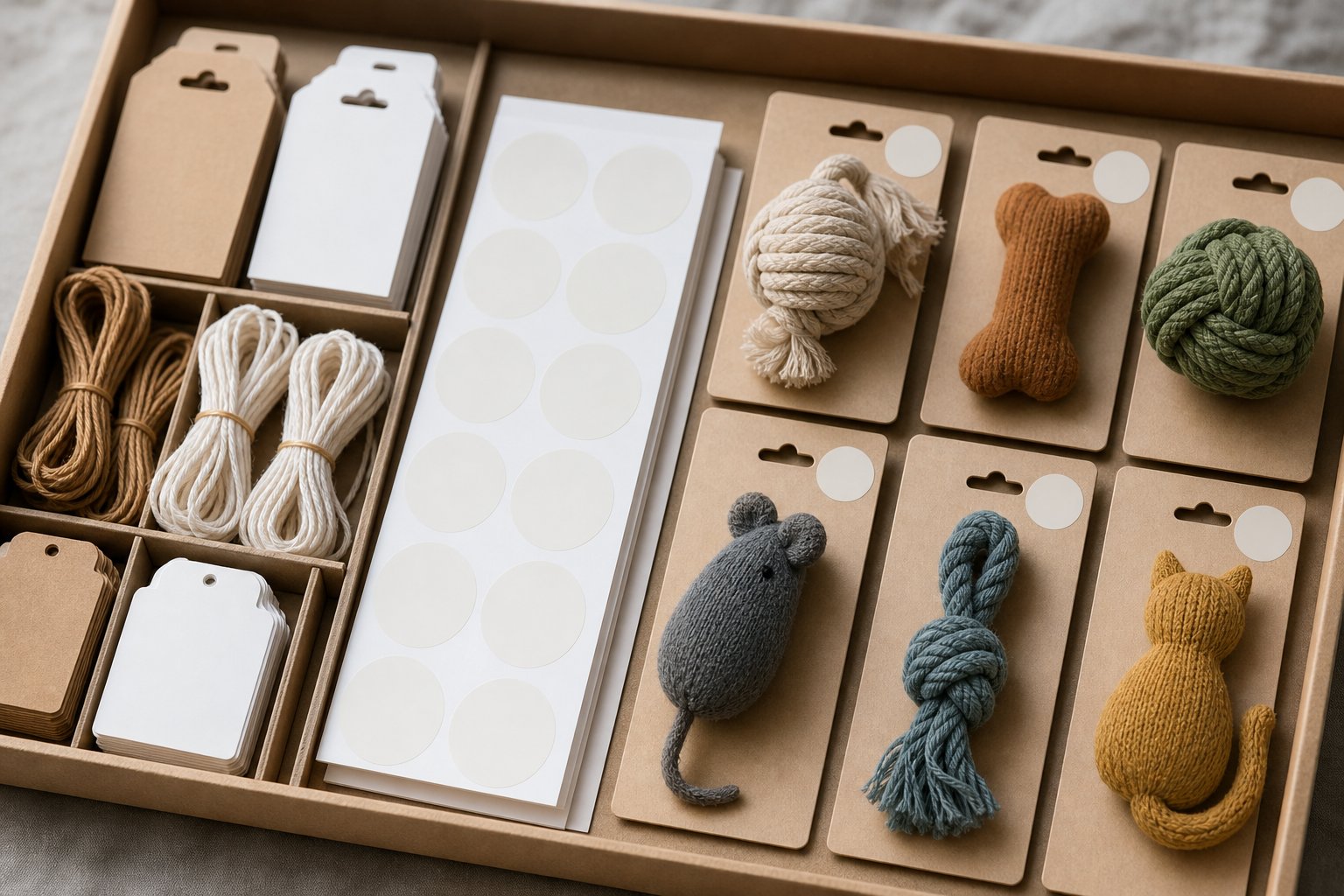
- The hangtag or header card. The marketing and claims surface: brand, materials story, care, barcode, and the market-specific operator block. This is the layer retail onboarding reviews line by line.
- The polybag and outer pack. Suffocation warnings are the industry norm for bags regardless of market; carton markings serve the warehouse, not the consumer, and belong to the logistics layer.
When a claim appears on one layer but not the others, audits ask awkward questions — "machine washable" on the hangtag of a plush with no care label sewn in is a small inconsistency that reads as a big systems gap. Say it once, completely, on the right layer.
One Label System, Many Markets
Multinational brands solve the multi-market problem with a two-part system. The base label carries everything shared across markets: brand, product name, materials, origin, care, barcode, and the safety information that never changes. Market stickers carry only what genuinely differs: the operator identity block, local-language safety lines, and market packaging marks where schemes such as France's packaging EPR labeling apply. The economics are obvious — one base artwork, cheap stickers — but the system has a known failure mode, and it happens at pack-out.
The wrong-market sticker is a recurring defect in consolidated shipments. Three controls prevent it: stickers are packed in labeled per-market cartons; the packing line checks sticker against the carton's market code; and the SKU's compliance file holds the artwork matrix so any auditor can verify which version belongs to which market. Label artwork belongs under version control exactly like a test report — the file, the approval date, the print vendor — a discipline covered in the dossier template.
Claim Hygiene on the Label
Finally, the words themselves. Labels inherit every claim discipline that applies to listings — durability and health claims need evidence, and pet toys have no legal basis for certification symbols such as CE, which the CE myths article dissects. Two habits keep labels clean. First, date-stamp claims to the evidence: if the tag says the toy passed a chew test, the test report for that SKU exists and is current. Second, keep instructions behavioral rather than promotional: what the product is for, how to clean it, when to replace it. Retail buyers in the UK and Japan in particular read instruction quality as a proxy for factory quality — a habit explored further in our article on selling into the UK and Japan.
Frequently Asked Questions
Is a country-of-origin label required on pet toys?
Whose address must appear on the EU label?
Do plush pet toys need care instructions?
Can one label artwork serve all markets?
Retail onboarding asks for label proofs?
Send the market list — we return label dielines with the operator blocks filled, care text per material, and FOB ranges including private-label packaging.