Key Takeaways
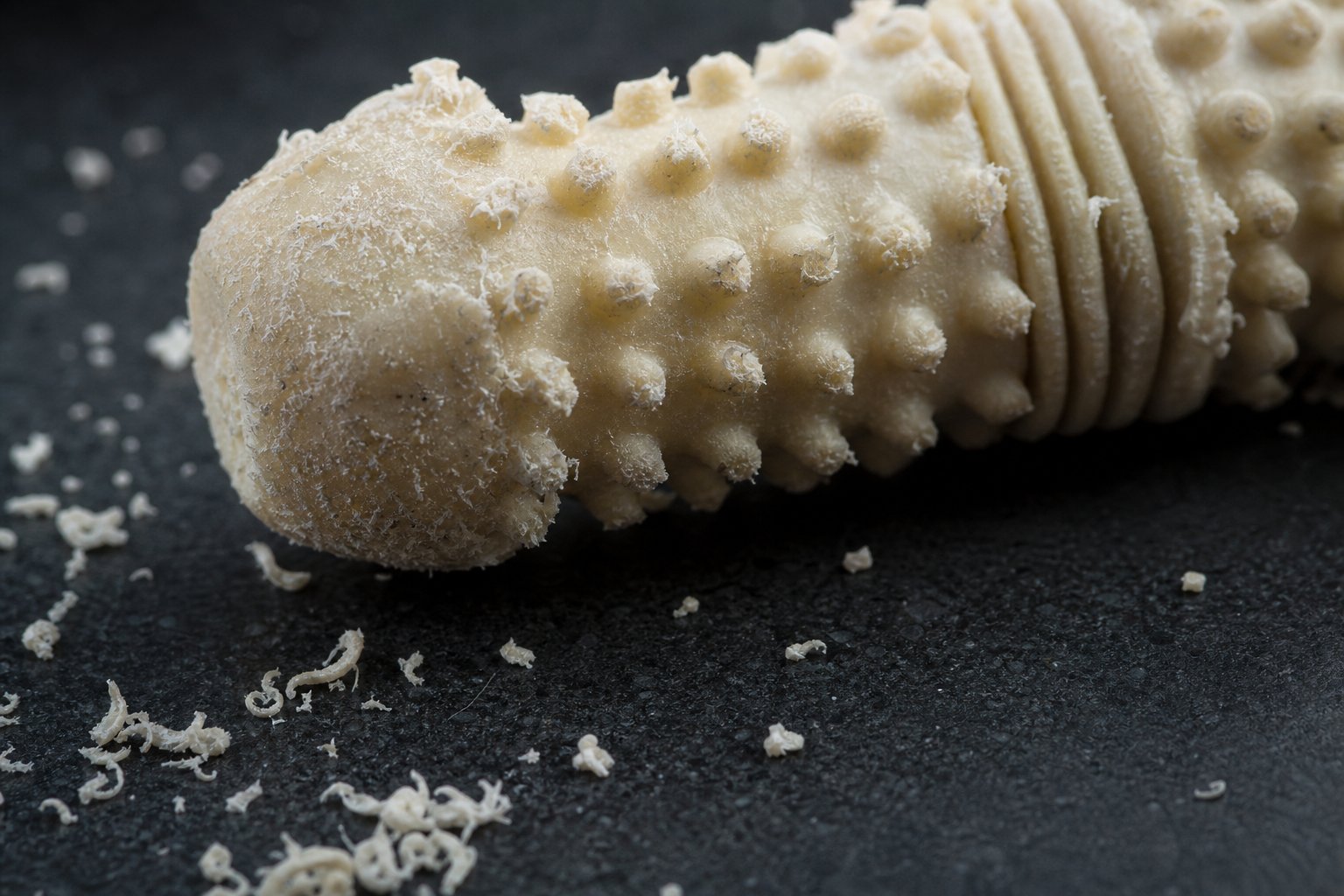
- Nylon does not tear — it abrades. Curly shavings under the bowl are the wear mode working as designed, and they are also your best QC talking point.
- Most nylon "failures" are sizing failures: a chew too small for the dog concentrates grinding and sheds faster.
- Flavor is compounded in through masterbatch, which is why it lasts the life of the chew — and why it has nothing to do with strength.
- Honest exclusions exist: seniors with weak teeth, teething puppies, gulpers and single-spot grinders belong on softer materials.
- Never let listings say "indestructible." Say "built for strong chewers, sized to the dog, wear monitored at home."
The word gets nylon chew toys into more trouble than any manufacturing defect: "indestructible." It prints well on packaging, ranks well in listings, and then a determined Malinois spends a weekend proving marketing wrong — or worse, a small dog gets a chew sized for a Labrador. Sizing and honest wear expectations, not superlatives, are what keep this category's reviews clean. That is the frame for this guide, written for buyers who are adding nylon SKUs to a chew range for the first time.
Nylon (polyamide, PA) holds a specific seat at the materials table: harder than any elastomer, indifferent to slobber, content to be ground for months. Used for the right dog at the right size, it is the chew aisle's closest thing to a long-duration product; used carelessly, it generates shavings complaints and returns.
How Nylon Wears: Shavings, Not Chunks
The defining behavior: under repeated grinding by a dog's back teeth, nylon micro-fractures at the surface and sheds fine, curly shavings. It does not tear or chunk the way TPR and rubber do. This wear mode is the product working as designed — the surface renews, the flavor inside re-exposes, the chew shrinks rather than failing catastrophically. It also answers the first question every buyer asks: what happens to the material the dog removes? Ideally it leaves as brushing-sized crumbs.
Hardness is the other half of the mechanism. Nylon chew grades sit far above elastomers on any durometer, which is why they feel "bone-like." The practical consequence is asymmetric: hardness protects the toy from the dog, but nothing protects the dog's teeth from the toy — which is why veterinary dentists urge supervision, and why honest positioning reads "long-wear for committed adult chewers," not "the hardest thing we sell."
Sizing: The Chart That Prevents Returns
Sizing failures dominate negative reviews, and they are preventable with a rule the whole range follows: the chew must be larger than the dog's muzzle span and thick enough that the dog cannot wedge it sideways between molars. As a factory-side selection grid:
| Dog class | Typical weight | Chew form that fits | Watch-outs |
|---|---|---|---|
| Small breeds | Under 10 kg | Short, wide bones and dumbbells; generous diameter relative to length | Never downsize a large-breed shape; thin ends become gulp hazards |
| Medium breeds | 10–25 kg | Standard bones and sticks with moderate thickness | First size up, not up-two — oversizing bores light chewers |
| Large breeds | 25–40 kg | Thick bones, rings and knots with reinforced cores | Check ends: flat, chamfered ends shed more evenly than pointed tips |
| Giant breeds | Over 40 kg | Oversized forms, maximum wall, minimal length-to-diameter ratio | Weight matters; a chew a dog can fling becomes a projectile |
| Puppies and seniors | Any | Not nylon by default — soft elastomers or fabric-first | Teeth and jaw strength, not body weight, set the material choice |
One more sizing principle worth writing into listings: size up when in doubt, and say so. "When between sizes, choose the larger" is a sentence that measurably reduces both shavings complaints and choking-scare messages — the two reviews that follow this category around.
Flavor: How the Meat Gets In, and What It Does Not Do
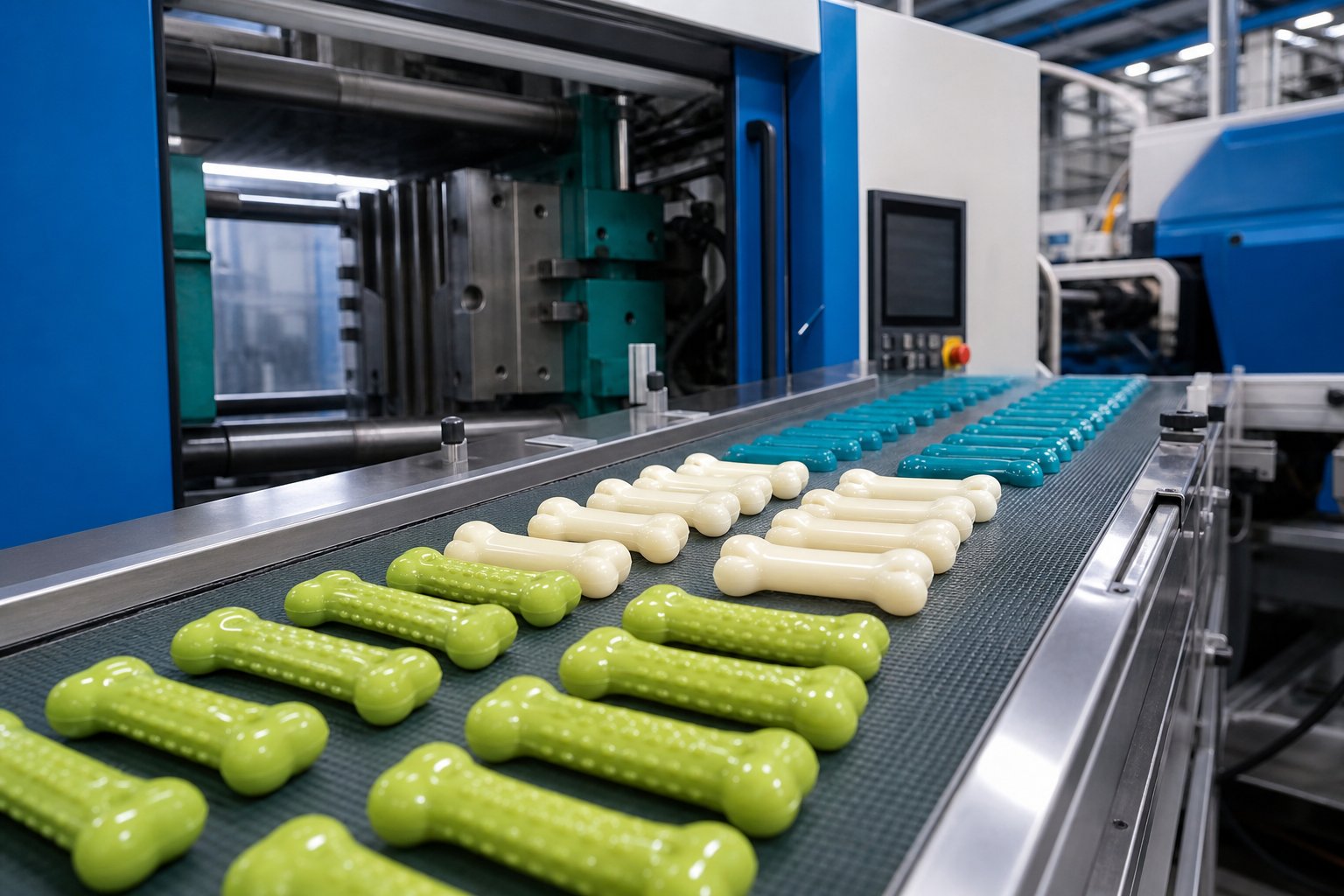
Nylon chews taste of nothing on their own, and palatability decides whether a dog commits hours to the toy — so flavor is a process question. The industry-standard route is a flavor masterbatch: flavor concentrate carried in a carrier pellet, blended with natural nylon resin at a declared loading, then dispersed through the part during molding. Because the flavor is distributed in the bulk material, every pass of the teeth exposes fresh flavored surface — the reason a nylon chew keeps interesting a dog for months while a sprayed coating would fade in a week.
Buyers should ask three things about flavor. First, the loading is declared, not a trade secret — you pay for it per kilo. Second, the system is disclosed enough for your market: palatability claims belong to the supplier's evidence, and wording like "bacon flavor" stays descriptive, not nutritional. Third, flavor changes palatability, not strength — a flavored stick is exactly as strong as its resin and wall design. Mixing those axes is how "flavored" quietly becomes "guaranteed unbreakable" in a shopper's mind.
The Honest Limits: When Nylon Is the Wrong Answer
A category page that never says "not for" will eventually answer a lawyer instead of a customer. The exclusions we put in sizing charts and listing copy:
- Seniors and dogs with dental disease — hard material against compromised teeth is a veterinary problem waiting for a date; offer soft elastomers instead.
- Teething puppies — puppy teeth are fine points on soft jaws; rubber-grade give is the safer default until adult teeth set.
- Gulpers — dogs that swallow rather than chew turn any hard toy into a geometry question; supervise or re-material.
- Single-spot grinders — a strong chewer fixated on one end will excavate it; rotate shapes or shorten sessions.
- Unsupervised first sessions — every nylon program should say it: first day with any hard chew is a watch-the-dog day.
Notice what these exclusions buy: a smaller audience on paper, a dramatically cleaner review profile in practice — the same trade we make when labeling durability ratings honestly, and the one that keeps reorders coming.
Writing Nylon Specs into the Order
Nylon forgives less sloppy specification than elastomers do, because there is no softness spectrum to hide in. Four fields keep a nylon program consistent across reorders: resin grade (virgin engineering PA, declared), flavor masterbatch system and loading (declared, with supplier's palatability evidence), wall thickness minimums per size (measured on the golden sample), and hardness confirmation on every batch — a durometer check that costs the factory minutes. If your supplier structure involves customization, our OEM/ODM page shows where each of these fields lives in an RFQ, and the materials matrix positions nylon against the elastomers it competes with on a chew shelf.
Handled this way, nylon becomes what it actually is: a disciplined, long-duration format for the strongest third of the chew market — sold to the right dogs, sized honestly, marketed without a single absolute in sight.
Frequently Asked Questions
Are nylon chew toys safe for dogs?
Why do nylon chew toys turn into shavings?
How is the meat flavor added to nylon chews?
Which dogs should not have nylon chews?
Adding nylon SKUs and want the size ladder specified correctly?
Send your dog-class breakdown — we return a sizing matrix, FOB ranges by size and the flavor and hardness specs for your first order.