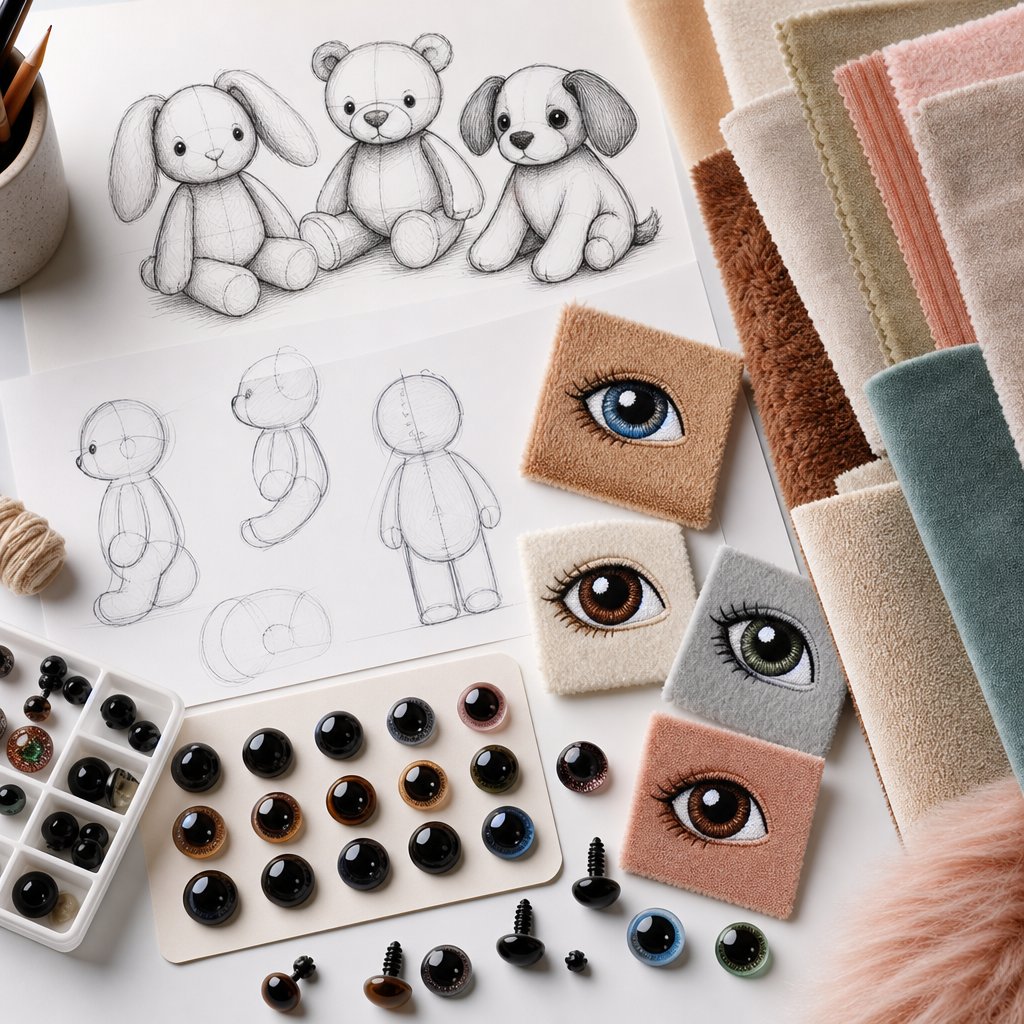
Key Takeaways
- Most pet toy incidents are design failures, not material failures: a part that detaches, a seam that opens, a strand that unwinds.
- Children's toy safety logic transfers to pets as engineering practice — small parts discipline, pull tests, edge checks — though no law requires it.
- Embroidered eyes and noses remove the detachable part entirely; plastic parts need locking backings and pull-off testing per batch.
- Seams fail at predictable points: limb roots, seam ends, the turning gap — reinforce by design, not by hope.
- Run a written design review before sampling; every rule in it costs cents at the pattern stage and recalls at the review-section stage.
Every sourcing team has done this autopsy: the customer's photo shows a plush toy in ruins, stuffing across the carpet, and somewhere in the frame the small, wet object that used to be a plastic nose. Nothing was wrong with the fabric. Nothing was wrong with the stuffing. The failure was decided months earlier, at a design desk, when somebody chose a snap-on eye to save three cents and nobody asked how it would survive forty minutes against a determined jaw.
Pet toy safety is mostly a design discipline, not a testing discipline. Testing finds the failure; design prevents it. This article collects the rules that decide whether a toy survives its first week — small parts, eye and nose attachment, seams, squeaker pockets and rope ends — and turns them into a checklist you can run before the first sample is cut.
Pets Are Not Children, but the Physics Is the Same
Children's toy standards such as EN 71 and ASTM F963 do not legally apply to pet toys — any suggestion of CE compliance for a dog toy is simply wrong. But the engineering behind them transfers almost perfectly, because the hazard is physical and shared: a detached part small enough to swallow, an edge sharp enough to cut, an attachment weak enough to pull off. The pet-toy-specific standard ASTM F2999 formalizes many of the same checks for pets — material hazards, sharp edges, squeaker attachment — and works well as the reference your product line is validated against.
The small parts lesson is the most transferable of all. Children's standards use a cylinder sized to a young child's airway to judge whether a detached part is a choking hazard. Dogs span a wider range of airway sizes than toddlers, so the professional adaptation is a sizing rule rather than one cylinder: nothing on a small-dog toy should be small enough to swallow whole, and nothing on any toy should break into fragments that pass that test either. Design for the worst chewer in the segment, not the average one.
Plastic Eyes and Noses Versus Embroidery
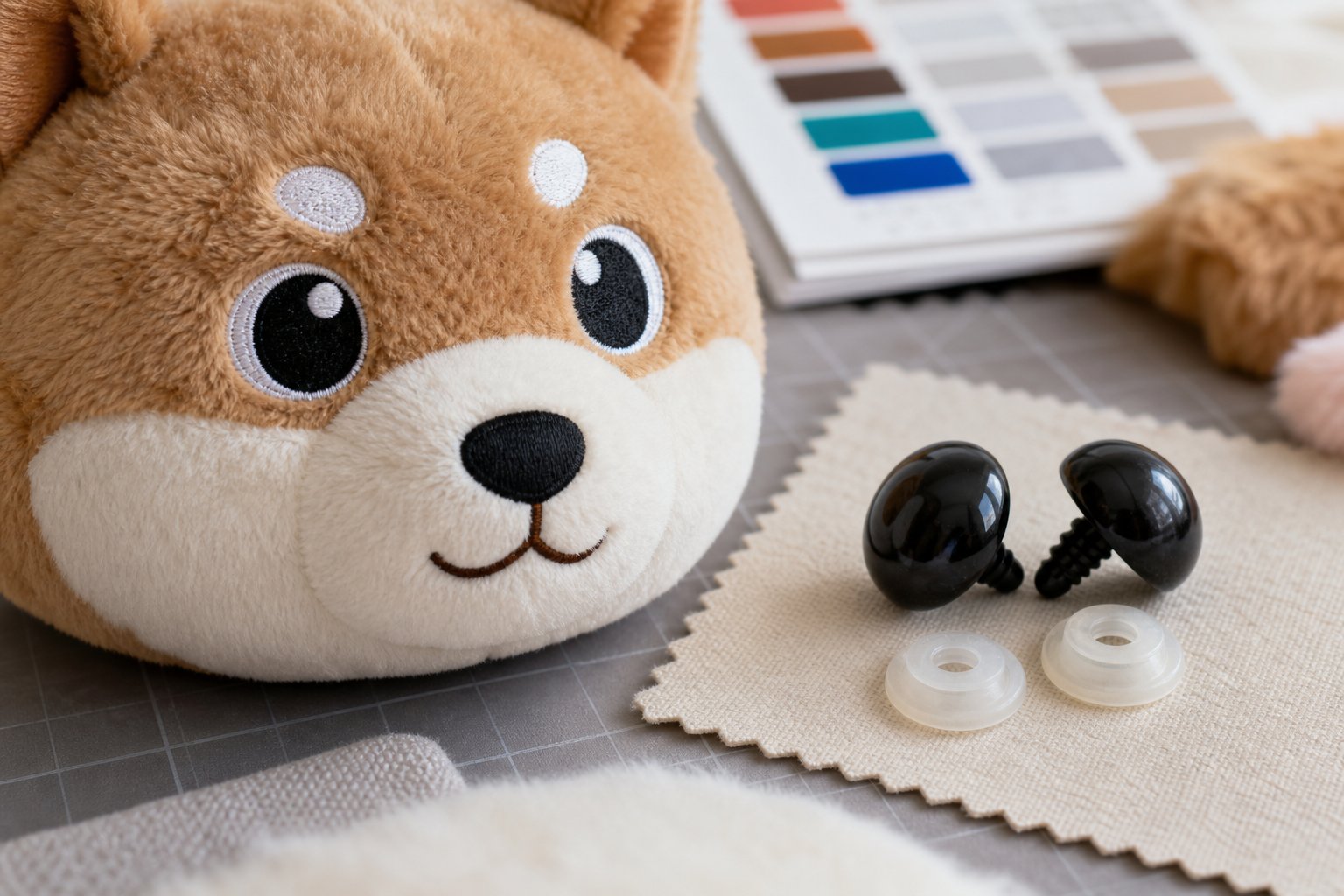
The face is where plush toys lose parts first. Plastic eyes and noses are fast, cheap and expressive — and each one is a detachable object held in fabric by friction. Three rules make them acceptable. First, the backing: a locking washer or metal-free snap backing that cannot rotate free, because a spinning disc saws its own way out. Second, the pull: attachment force should be verified against toy-standard pull test practice on sampled units every batch, not just on the golden sample. Third, the fit: the post length matches the fabric stack, so overtightening cannot punch the backing through.
Embroidery removes the problem class entirely — there is no part to detach, only thread to wear. It costs more per unit, flattens the expression, and shifts the failure mode to thread wear and fabric abrasion. Our rule of thumb: embroidery is the default for toys marketed to aggressive chewers and to dogs left alone with the toy; snap-backed plastic parts remain acceptable for interactive, supervised play SKUs — provided the pull test data exists. The trade is yours — made consciously, per SKU, not per price negotiation.
Seams: Where Plush Toys Actually Fail
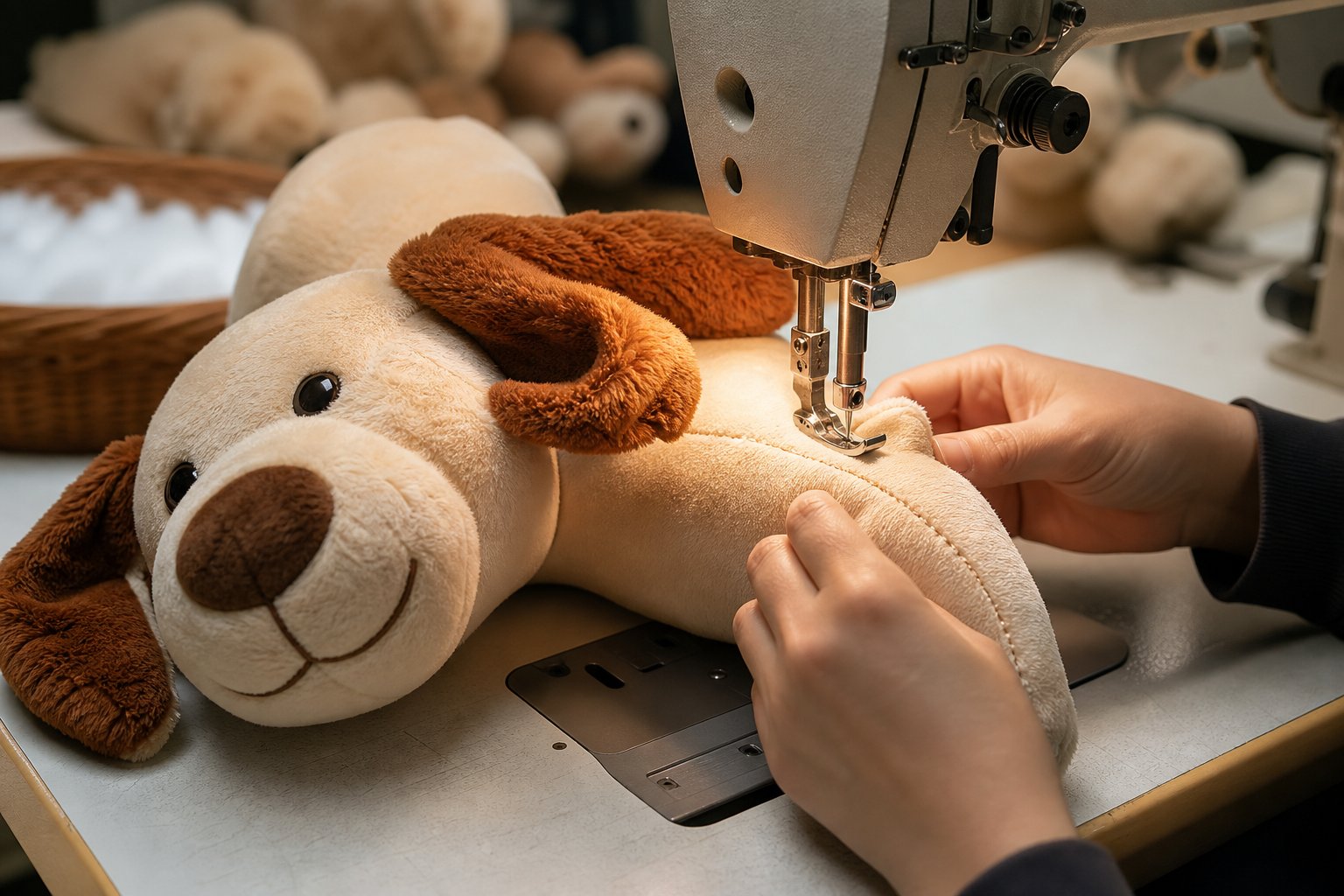
Ask a sewing floor where a plush toy dies and they will not say "the seam" — they will say which seam. Failures concentrate at predictable stress points: the root of a limb where leverage is longest, seam ends where the stitch chain starts and stops, and the turning gap that was closed in a second pass. A durable toy is specified against that map. Lockstitch rather than chainstitch, so one broken stitch does not unzip the toy. Stitch density scaled to the dog size tier — tighter for power-chewer lines, relaxed for cuddle SKUs. Reinforcement passes — bar tacks or double rows — at limb roots and seam ends. And a seam-strength check written into the inspection standard, so the specification is measured rather than assumed.
None of this is exotic; it is the difference between a factory that sews to a spec and one that sews to a rhythm — invisible in a sample photo, which is why it must be written down. Our piece on what goes inside a plush toy covers the interior half.
Squeaker Pockets, Rope Ends and Other Geometry Rules
Geometry is the cheapest safety feature in the catalog. A squeaker loose in the stuffing can migrate to any seam; one sewn into its own fabric pocket stays where the design put it, attached to something larger than a windpipe's bad day — the attachment logic is detailed in our squeaker pull test article. Rope toys die at their ends: a cut end frays into strands, and a swallowed strand is an obstruction, not a nuisance. Knotted, woven-in or heat-tucked finishes, sized so no single strand loop can trap a tooth or tongue, are the standing rule. Felt and fabric appliques follow the same small-parts sizing logic as eyes, and any rigid frame inside a soft toy needs rounded ends and its own attachment check.
| Component | The failure it causes | Design rule | Verification |
|---|---|---|---|
| Plastic eyes / noses | Detachable small part; choking | Locking backing, matched post length, size above swallow threshold | Batch pull test against toy-standard practice |
| Embroidered face | Thread wear, fabric abrasion | Backed with interfacing; no raised knots a tooth can catch | Wear rub on sampled units |
| Seams | Open seam, stuffing out | Lockstitch, tier-scaled density, bar tacks at stress points | Seam-strength check per inspection standard |
| Squeaker | Loose unit migrating to a seam | Sewn fabric pocket, fixed orientation | Pull-off force per batch |
| Rope ends | Fraying strands, obstruction | Knotted / woven / heat-tucked finish, no trap loops | Shedding and unravel limit at QC |
A Design Review Before the First Cut
Rules only work if somebody runs them before sampling. The review we run on new plush SKUs takes under an hour:
- List every detachable or frangible component and size it against the smallest dog in the target segment.
- Decide face treatment per SKU — embroidery or backed plastic — and write the pull test plan beside the decision.
- Mark stress points on the pattern: limb roots, seam ends, turning gap, applique edges.
- Fix squeakers in pockets, ropes with finished ends, rigid parts with rounded, anchored geometry.
- Sign the review into the tech pack so the sewing floor, the QC team and the third-party inspector read the same document.
Safety decisions made here cost cents. The same decisions made after a shipment lands cost a season of reviews — and the criteria we hold new designs to are public on our quality page.
Frequently Asked Questions
Are plastic eyes and noses safe on plush dog toys?
What seam construction should I demand for plush dog toys?
How should rope toy ends be finished to prevent fraying and swallowing?
Can children's toy safety rules be applied to pet toys?
Reviewing a new plush design?
Send drawings or a competitor reference — we run the safety review, quote it across materials and reply with FOB ranges by construction.