Key Takeaways
- The market wins the sticker price on small mixed lots; the factory wins the total cost on volume — they are different games, not one ranking.
- Total cost per sellable unit includes inspection, defect allowance, rework, agent fees and consolidation losses — not just the tag on the shelf.
- The market's superpowers are breadth, carton-level MOQ and immediate stock; the factory's are consistency, customization, documents and recourse.
- Hidden costs run both directions: agent fees and provenance risk at the market, MOQ and slower first response at the factory.
- Most mature programs run both: factories for proven winners, the market for tests and tails — ideally with one consolidation point over both.
Two buyers once showed us invoices for what looked like the same squeaky duck. One bought through a Yiwu market stall, carton by carton, at a price that made her spreadsheet sing. The other contracted the factory that actually manufactured the duck. The sticker gap was real — and mostly irrelevant, because the market buyer's second order arrived a shade darker, her listing takedown for missing documents cost a selling month, and her "supplier" was a merchant who had bought the ducks from someone else. Total cost per sellable unit told the opposite story to the one on the tag.
Factory-direct versus the market is not a morals play. It is two service models with different economics, and the skill is knowing which cost lines each one hides.
Two Routes, Honestly Defined
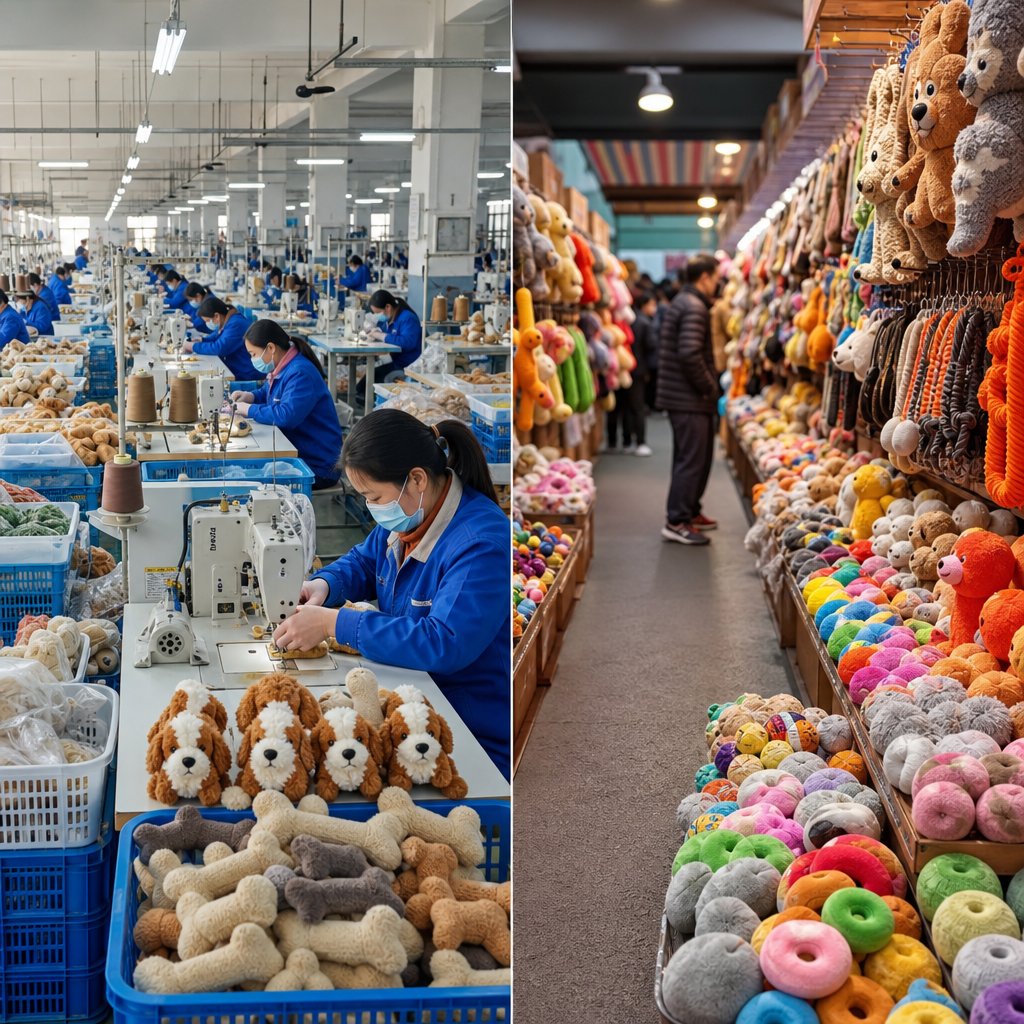
The Yiwu route means buying through trading rows — at the International Trade Market, whose dedicated pet zone spans roughly 8,000 square meters and lists more than 30,000 individual items, within a city whose pet ecosystem is commonly cited at over 10,000 related businesses and annual exports above RMB 3 billion. Some stalls manufacture; most aggregate from factories near and far. The factory route means contracting the producer: you negotiate with the entity that owns the line, the mold and the QC bench.
Neither is a scam and neither is a religion. A market is a discovery instrument with logistics attached; a factory is a manufacturing commitment with a catalog attached. Problems start when buyers use one as the other.
Sticker Price versus Total Cost
Laid line by line, the comparison stops being an argument and becomes arithmetic:
| Cost line | Yiwu market route | Factory-direct route |
|---|---|---|
| Unit price, small mixed lots | Usually lower — stalls live on breadth and break cartons | Higher at small quantities; MOQ floors apply |
| Unit price, proven winners at volume | Markup stacked on factory price | Lower — you are already paying the base |
| Sampling and customization | Limited to what a backing factory will do for a reseller | Full loop: pattern, colorway, packaging, materials |
| Quality consistency across reorders | Depends which factory filled the order this time | Golden samples, named lines, batch discipline |
| QC depth | Your own inspection or a hired third party | In-line and pre-shipment QC you can contract |
| Documents and test reports | Often unavailable or not in your entity's name | Reports and declarations aligned with the producer |
| Defect recourse | Negotiated stall by stall, weakest at reorders | Contractual AQL with claims against the producer |
| Agent and handling fees | Buying agent plus export-agent markup if you use one | None beyond the quoted price structure |
| Consolidation losses | Mixed-vendor loading; occasional substitutions | Factory ships what was approved |
The unit-price rows are the ones everyone negotiates. The bottom four rows are the ones that decide margins.
What the Market Genuinely Wins At
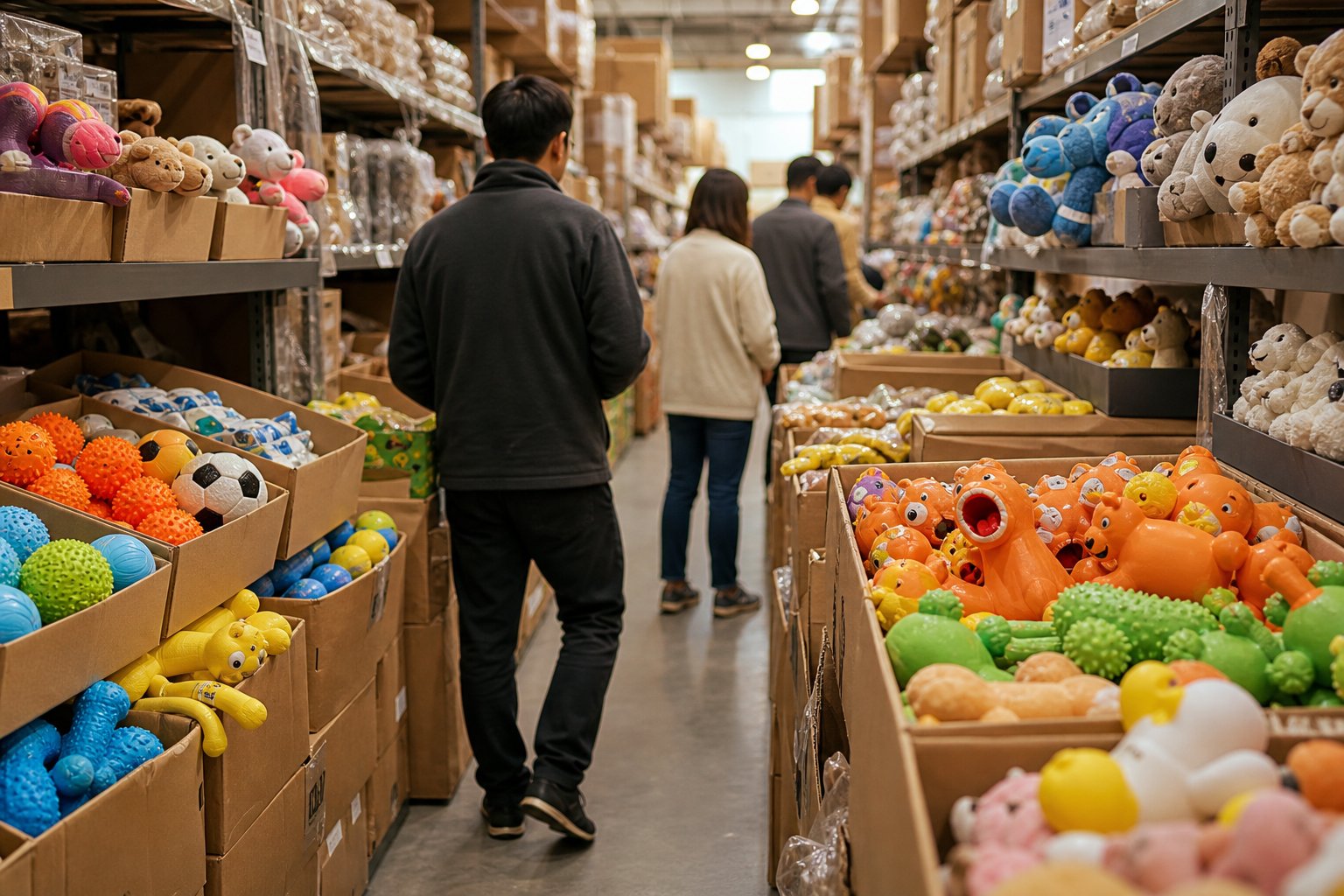
- Discovery. Thirty-thousand-item breadth turns trend-spotting into a morning's walk instead of a month of catalogs.
- Carton-level MOQ. Stalls sell by the box and mix designs, so a twelve-SKU test fits in a budget no factory could quote.
- Immediate stock. Goods on the shelf ship this week; there is no production calendar between you and the cartons.
- Price transparency. Walking five stalls selling the same duck tells you the street price faster than any RFQ round.
For validation — is this design worth a listing at all? — the market is the cheapest honest answer in the industry.
Where Factory-Direct Pulls Ahead
The moment a SKU proves itself, the calculus flips. Factory-direct gives you the golden sample as the legal reference, a named line that must match it, and an AQL — Critical 0 / Major 2.5 / Minor 4.0 is the consumer-products norm — with recourse against a manufacturer rather than a merchant. Customization opens up: your colorway, your hangtag, your packaging, your material spec. Documents align: test reports requested from the producing factory carry its name and can be reissued when regulations or platforms ask. And at volume, the unit price gap stops being a gap, because the market markup was always your money paying for someone else's aggregation.
Our own tiers price this honestly: private label over stock from 200 pieces per style, OEM customization from 1,000, ODM tooling from 3,000 — with production at 25–35 days and first ODM orders at 45–60 days including tooling.

Hidden Costs That Rarely Make the Quote
On the market side: buying-agent and export-agent fees if you delegate; consolidation losses when mixed-vendor cartons arrive short or substituted; the provenance problem — you may not know which factory made what, which complicates every compliance question; and reorder variance, because the stall that sold you August's duck may source October's from a different workshop. On the factory side: MOQ capital tied up in one design, a slower first response while the factory decides whether you are worth its capacity, and tooling exposure on customized items.
None of these appear on the proforma invoice. All of them appear in the annual P&L.
The Stage-by-Stage Play
| Your stage | Lean | Why, and the typical move |
|---|---|---|
| Validating a category | Market | Carton-level tests across many designs; keep receipts tight so winners are traceable |
| First repeat winners | Hybrid | Take the winner factory-direct; keep tests and tails at the market |
| Building a brand line | Factory | Custom colorways and packaging need the producing entity, not a reseller |
| Scaling a catalog | Hybrid, consolidated | Factories per category, one consolidation hub for mixed containers and dropship |
The hybrid only works with one discipline: whatever the route, QC exists before shipment. Buyers comparing routes will find our belt versus factory breakdown and Yiwu market guide useful next steps, and our dropshipping page shows how the consolidation half runs in practice.
Frequently Asked Questions
Is the Yiwu market always cheaper than factory-direct?
What MOQ can I realistically get at the Yiwu market?
Do market goods come with test reports?
When should a buyer switch from market buying to factory-direct?
Want both routes priced on your real assortment?
Send the SKU list — we will quote the stock and factory-direct lines side by side, with FOB ranges and dispatch dates for each.