
Key Takeaways
- Q4 pet gifting is three waves — Halloween, the December holidays, and a long tail of gifting occasions — each with its own order deadline.
- Plan backwards from the shelf date: production, ocean transit and receiving together consume most of a quarter.
- The season's second-order risk is Chinese New Year, which collides with your January replenishment.
- Holiday packaging is a development node with its own calendar, minimums and lead times.
- A late decision is not a lost season: stock programs with private label can bridge — at the cost of some differentiation.
If you are reading this in June, the fourth quarter has already started. Retail buyers allocate holiday shelf space in early summer; the toys that will sit in October endcaps are being quoted right now. Pet gift demand is no longer a niche footnote either — the National Retail Federation projected roughly USD 860 million of US spending on pet costumes alone for Halloween 2025, and toys ride the same treat-your-pet basket. Sellers who treat Q4 as an October problem consistently meet it with November inventory.
This article is a working calendar: the demand waves worth planning around, a countdown from purchase order to shelf, the Chinese New Year trap that catches Q4 sellers in Q1, and the packaging milestones that refuse to compress.
Three Waves, Not One Holiday
The season is usually drawn as one block, but it behaves as three. Halloween arrives first and is the most visual: themed plush, squeaky characters and costume-adjacent accessories, with a hard date. The December holidays are the volume wave — gifting bundles, premium packaging, higher price tolerance — and they also carry the year's largest general-retail traffic. Behind both runs a long tail with no calendar at all: pet birthdays, adoption days and self-treat purchases, which industry surveys suggest drive a substantial share of toy spending year-round.
The practical consequence is that one Q4 order rarely fits all three waves. Halloween SKUs sold through by mid-October are invisible in December; December packaging looks tired in the Halloween aisle. Two purchase orders — or one split shipment — usually outperform one optimistic order, even at slightly higher freight cost.
The Countdown: From Purchase Order to Shelf
Work backwards from a shelf date and the calendar stops being negotiable. Production on custom or private-label toys typically runs 25–35 days including inspection. Ocean transit to North America or Europe adds roughly four to six weeks door to door in normal conditions, plus customs clearance and retail receiving windows. Add packaging approval and a buffer for one revision, and the quarters fill themselves:
| Target shelf date | PO confirmed by | Production window | Ship by | Notes |
|---|---|---|---|---|
| October 1 (Halloween) | Mid-June | July | Late July–early August, sea | Design freeze and dielines in May–June; air freight only for top-ups |
| November 15 (holiday build) | Early July | August | September, sea | Gifting bundles and premium packaging approved with the sample |
| December 1 (peak) | Late July | September | Early October, sea | Last reliable sea window before peak congestion |
| January replenishment | October–November | December | Before mid-January | Beats the Chinese New Year shutdown; otherwise ship after the holiday |
Two footnotes to the table. Air freight rescues margin, not seasonality: it moves cartons in days but at a per-unit cost that erases the economics of light, bulky toys. And every row above assumes the factory's line is free — in peak season, capacity is booked by the earliest buyers, which is a better argument for a June PO than any discount.
The Chinese New Year Overlap
Here is the risk that Q4 sellers discover in Q1. The factories behind your season shut down for the Spring Festival — commonly two to four weeks, with staffing and material supply ramping back gradually for weeks after. An order placed casually in December for January delivery is competing with pre-holiday freight for vessel space, then with the shutdown itself for production time. The belt-level rhythm — how the cluster breathes around the holiday — is described on our factory and industrial belt page, and the timing mechanics are covered in depth in our Chinese New Year and Q4 stock article.
The defensive moves are unglamorous: confirm Q1 needs before December, ship the January cover before mid-January, and hold a small buffer of evergreen SKUs so a two-week slip is an inconvenience rather than a stockout.
Holiday Packaging: A Development Node of Its Own
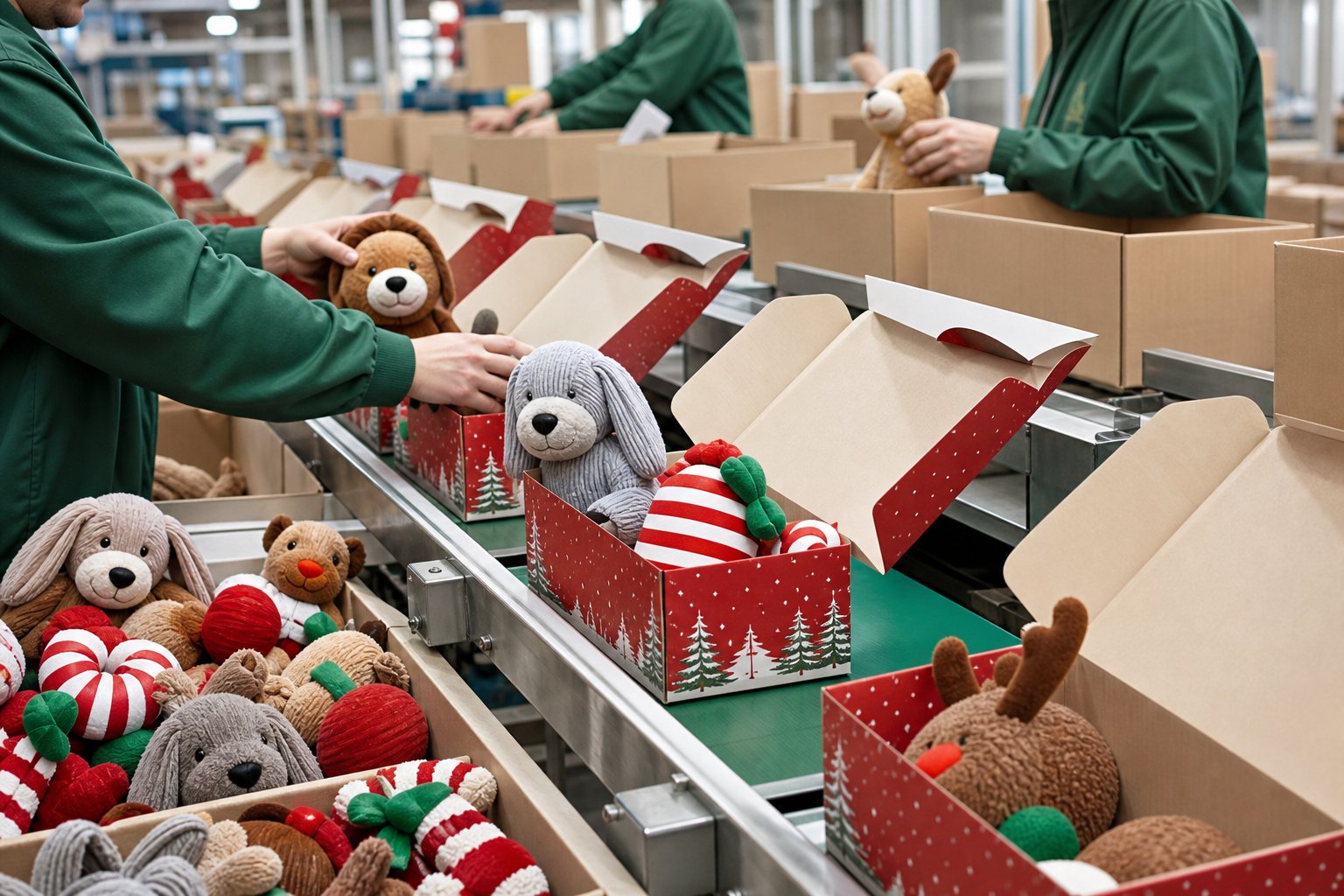
Gift-facing toys sell on the shelf, and the shelf sees packaging first. That makes packaging a development track with its own milestones: concept and dieline at design freeze, print proof with the pre-production sample, and a print run that carries its own minimum order quantities and one to two weeks of production. A header card and polybag are quick; a window gift box with inserts is not. The cost mechanics — hangtags, header cards and boxes line by line — are broken out in our private label packaging article.
For e-commerce-first sellers the logic inverts: compression-friendly packaging that survives parcel networks matters more than shelf theater, and holiday theming can live on a sticker or insert rather than the box. Decide which game each SKU is playing before the dieline is drawn.
Assortment Architecture for the Gifting Aisle
A Q4 range that converts usually has three shelves in one order: an accessible entry tier at gifting-friendly price points, a hero tier with premium packaging that photographs well, and bundle formats — multipacks or themed sets — that lift average order value. Bundles also carry operational weight: fewer SKUs to track than the same units sold singly, and gift recipients are more forgiving of assortment choices than the buyer is of a dead shelf. Keep the bundle composition inside SKUs that already exist, and the whole tier becomes a packing decision rather than a tooling decision.
- Lock the wave plan first: which SKUs serve Halloween, which serve December, which serve both.
- Set the PO date from the calendar above, not from when the design finally feels finished.
- Approve packaging proofs with the production sample — never as a separate, later step.
- Decide the January cover in October: ship early or buffer stock locally.
- If timing has already slipped, ask about stock SKUs with private label before asking about air freight.
Frequently Asked Questions
How early should I order pet toys for the Q4 season?
Does Halloween matter for pet toys, or is it only costumes?
What is the Chinese New Year risk for Q4 sellers?
Do holiday pet toy SKUs need special packaging?
Still holding a June calendar? It can hold Q4.
Send your shelf date and category — we reply with a dated production plan, packaging options and what our stock program can bridge this season.