
Key Takeaways
- A failed batch costs more than its invoice: goods, freight, refunds, fees, review repair and management time stack on top of each other.
- In worked ledgers the total commonly lands at two to three times the goods value — the exact multiplier varies, the order of magnitude does not.
- Review-driven categories pay a second bill: rank and conversion damage outlive the refunds.
- Prevention is priced in hundreds; failure is priced in thousands — the asymmetry is the entire business case for inspection.
- The ledger is knowable in advance. Build it before ordering, not after the first complaint.
Nobody budgets for the batch that fails. The purchase order budgets goods, freight and a margin; the spreadsheet does not contain a line called "the squeakers come out." And yet every number in a quality failure was knowable in advance — which is exactly why writing the ledger down before ordering, as an exercise, changes how buyers negotiate, inspect and choose suppliers. This article walks one failure end to end, itemizes what it actually costs, and sets the ledger against what prevention would have cost.
Every figure below is an illustrative assumption on a deliberately round hypothetical: a 5,000-unit order of plush squeaky toys. The purpose is the structure, not the numbers.
Anatomy of a Failed Batch
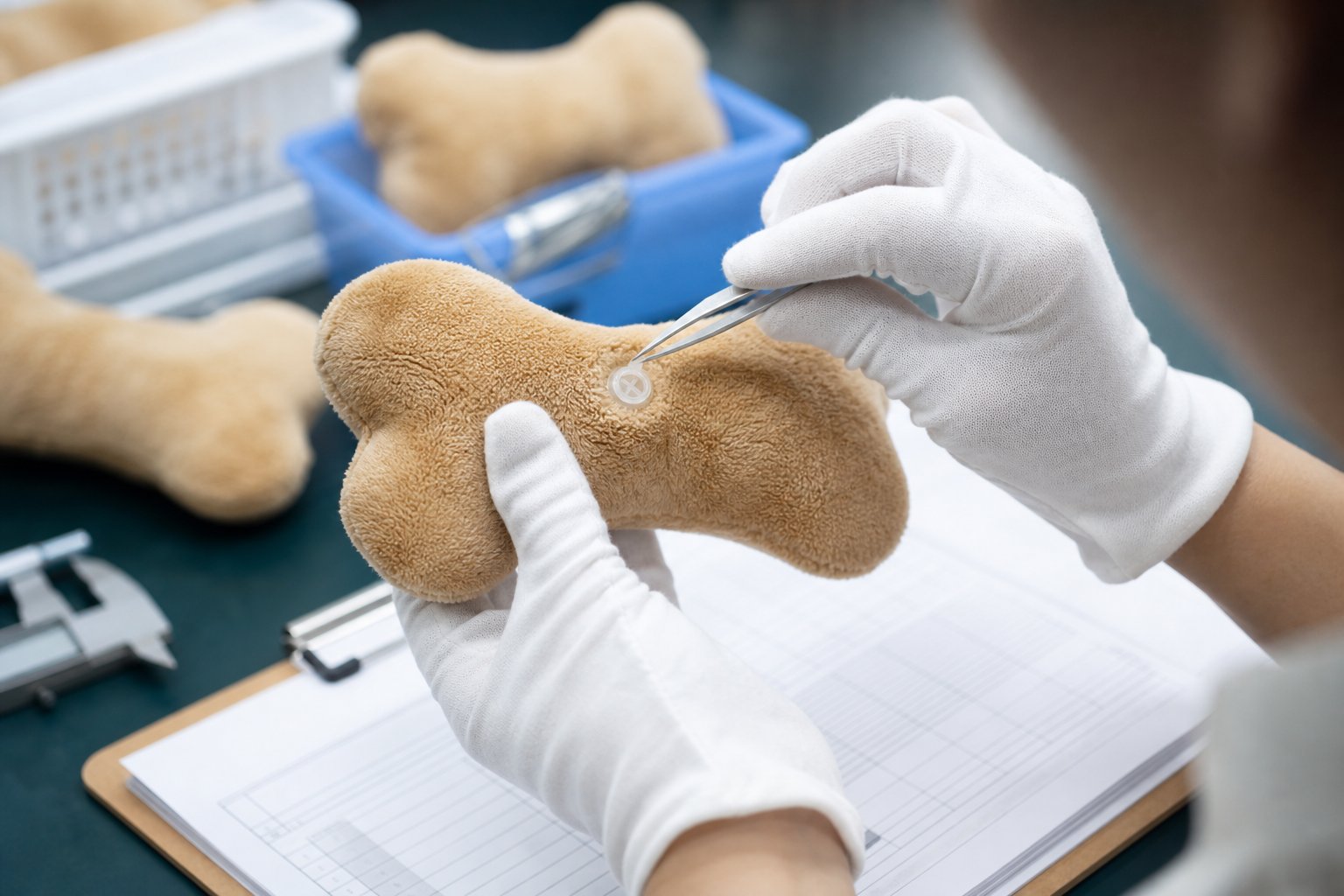
Consider the classic: squeaker detachment. The batch ships clean — factory QC checked appearance and stitching, and a detached squeaker is invisible in a packed carton anyway. Three weeks after launch, reviews start saying the same sentence in different words: the toy stopped squeaking, and the plastic unit came out. A few customers mention a swallowed-squeaker scare at the vet. This is the moment the failure stops being a factory event and becomes a brand event, because the next decisions — pull the listing, review the batch, message customers — belong to the buyer, at the buyer's cost, on the buyer's clock.
The mechanics of why it happened are almost always documented in hindsight: attachment stitching narrowed in a line-speed push, or the glue-and-seat step was skipped on a night shift. For the ledger, the cause matters less than the shape of the bill that follows — and the bill has more lines than buyers expect.
The Worked Ledger
Here is the failure account for the hypothetical batch, with every assumption stated. The goods were 5,000 units at 1.20 per unit FOB — a goods value of 6,000. Freight of 1,500 was paid and is not coming back. Assume reviews surface the issue when 15 percent of the batch has sold, and half of those customers complain:
| Cost line (illustrative assumption) | Basis | Amount |
|---|---|---|
| Goods value at risk | 5,000 units at 1.20 FOB | 6,000 |
| Sunk inbound freight | Paid at shipment | 1,500 |
| Sorting and inspection labor | Re-check 4,250 unsold units | 900 |
| Refunds and marketplace fees | 375 complaints, full refund plus fee loss | 1,900 |
| Review remediation | Discounts and goodwill credits | 800 |
| Management time and rework admin | Claims, supplier negotiation, relisting | 600 |
| Velocity and rank damage | Weeks of suppressed conversion while rating recovers | 1,200 |
| Total failure cost | Against 6,000 of goods | 12,900 |
Two features of this ledger deserve a pause. First, the ratio: the total is a little over twice the goods value — and that is with the failure caught early, the unsold stock still sellable after rework, and no formal recall process. A batch that reaches more customers, or triggers a safety narrative, climbs faster. Industry quality-cost practice has long observed that failure costs run at multiples of the goods involved; the worked numbers simply show why. Second, the least reversible line is the last one: money refunded can be re-earned, but ranking and review averages compound against you for quarters.
What Prevention Would Have Cost
Set the same failure against the boring alternative. A pre-shipment inspection with a written defect catalog — squeaker pull test included — is commonly quoted in the low hundreds of US dollars per inspection day in China, and would have caught an attachment failure before the container closed. A golden sample program, sealing the approved attachment method with signatures, costs administration rather than money. Batch retention — our standard is three sealed units per batch kept 24 months — converts any later dispute from archaeology into paperwork. Total prevention package: a few hundred on a 12,900 exposure. The asymmetry is not subtle, and it is stable across batch sizes: prevention scales with inspection days, failure scales with units.
The honest caveat is that inspection does not guarantee zero — it shifts the detection point from the customer's living room back to the factory floor, where a caught defect costs a rework instead of a brand event. Residual risk stays in the model; it just stops being the dominant term. How to decide when third-party eyes are worth adding to factory QC is covered in our third-party inspection decision guide, the physics of the squeaker failure itself — attachment strength as the recall-deciding variable — is the subject of our pull test article, and the full protocol sits on our quality standards page.
Building Your Own Ledger Before You Need It
The exercise takes an hour and pays for itself in the first negotiation it changes. For each SKU family, write down: order value and freight at stake; your realistic complaint rate if a Critical defect ships (for anything mouth-adjacent, assume complaints arrive); refund plus fee cost per complaint; a remediation budget; management hours at a loaded rate; and a velocity-damage allowance for marketplace channels. Sum it, and keep the sum in your cost model as a standing risk line — the number that makes a few-hundred-dollar inspection feel proportionate, a vague supplier assurance feel expensive, and a defect catalog feel like what it is: the cheapest contract clause you will ever negotiate.
- Price the prevention package per shipment — inspection day rate, pull tests, sample retention — and hold it against the ledger.
- Write the defect catalog into the contract: named Critical defects, including small-part detachment for mouth-contact toys.
- Seal golden samples with signatures, and retain per-batch units with dates.
- Pre-agree the failure protocol: who is called, within what hours, with what evidence and remedy.
- Review the ledger once a quarter with real data from returns and reviews, and let it re-rank your suppliers.
Frequently Asked Questions
What does a failed pet toy batch really cost beyond the invoice?
Is it cheaper to inspect shipments or to hope?
Who pays when a defect is found — the buyer or the factory?
How do I estimate my own quality-failure exposure?
Want the prevention package priced for your batch size?
Send your category and volume — we reply with our QC protocol per SKU family, the defect catalog we sign, and what inspection adds per shipment. Our quality page shows the standards first.