Key Takeaways
- Most plush toys do not fail at the fabric — they fail at one seam, usually the closing opening or a limb-root anchor.
- Four parameters decide seam performance: stitch density, thread, seam allowance and closure. Demand all four in writing.
- The stuffed-toy benchmark adapted from children's toy protocols is a clamped pull of roughly 70 N (15 lbf) without filler exposure — a clean contractual starting point.
- Scale the seam configuration to dog weight: what holds for a chihuahua toy will not hold for a retriever.
- Verify at three points: golden sample teardown, in-line spot pulls, final inspection with open seams in the AQL catalog.
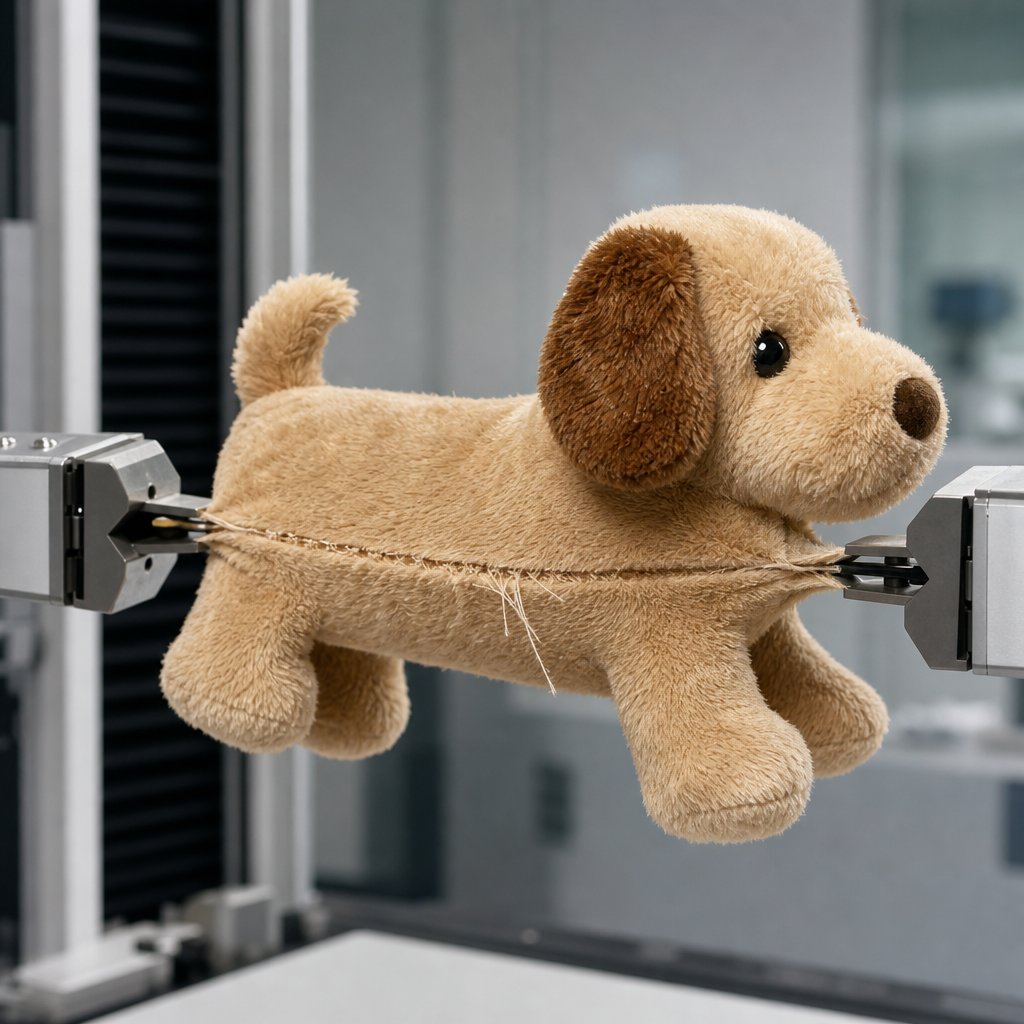
Ask any brand with plush returns what kills its line, and the answer is rarely the fabric. It is one seam — most often the one that closes the body after stuffing, or a limb junction. A dog does not bite politely: it shears, pries, shakes and carries the toy by its ear, and every load lands on a few centimeters of stitching. That is why buyers treat seam strength as a tested number rather than a hope.
This article sets out the numbers worth demanding: stitch density, thread construction, closure technique and a pull benchmark adapted from children's stuffed-toy protocols. No spec makes a plush toy unbreakable, and honest sourcing never promises that. A seam spec moves the failure point far enough out that the toy is retired before it splits.
Where Plush Toys Actually Fail
Returned plush follows a predictable failure pattern. Four mechanisms dominate, and only the first is a true seam problem — but all four end the same way, with filler exposed:
- Opening-seam failure. The closing seam is closed after stuffing, often by hand with a ladder stitch. It carries the same loads with half the reinforcement, which is why it usually opens first.
- Thread breakage. Low-grade spun thread abrades against the needle eye and the dog's teeth, snaps at one point, and the seam unzips like a pulled sweater thread.
- Anchor-point tearing. Ears, tails and squeaker pockets act as levers. A firm bite on an ear transmits the full force to four or five stitches at the root, and the fabric around them tears.
- Filler exposure. Once a seam gaps more than a finger's width, PP fiber and the squeaker are accessible — the moment a durability complaint becomes a safety ticket.
The implication: a seam spec that only says "double stitched" is not a spec. It says nothing about the closing seam, the thread, or the force the result must withstand.
The Four Numbers That Define a Seam
Plush factories work with four levers, each with a normal working range you can write into a purchase order:
- Stitch density. The common plush range is roughly 9–11 stitches per 3 cm. Below about 8, seams gap under flexing; above about 12, the needle perforates the fabric so densely that the seam line tears like perforated paper.
- Thread construction. Core-spun polyester is the default for stress seams. Cotton photographs well but loses much of its strength when wet — a saliva problem — and thin monofilament-style threads cut through plush pile.
- Seam allowance. A 5–8 mm allowance on body panels keeps stitches from biting the fabric edge; narrower allowances fail from the edge inward regardless of stitch count.
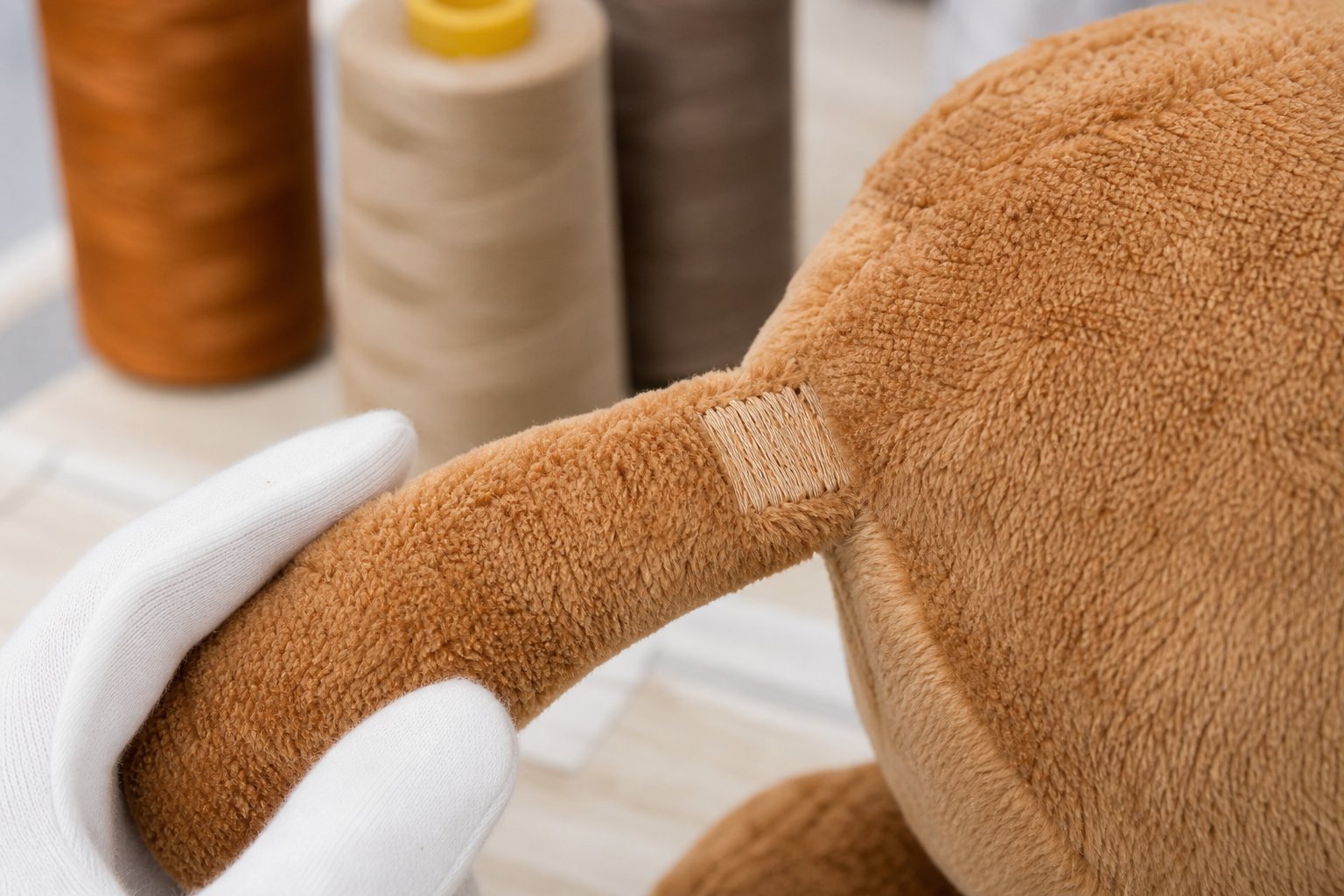
- Closure and bartacks. Machine-closed openings with a bartack, or hand closures backed by a second line, above the toy-dog tier; bartacks at limb roots, tail roots and squeaker pockets.
These four interact: dense stitching with weak thread still unzips; strong thread at eight stitches per 3 cm still gaps. Specify them as a set, and photograph the values on the golden sample so both sides agree on what "correct" looks like.
The Benchmark Worth Borrowing from Toy Standards
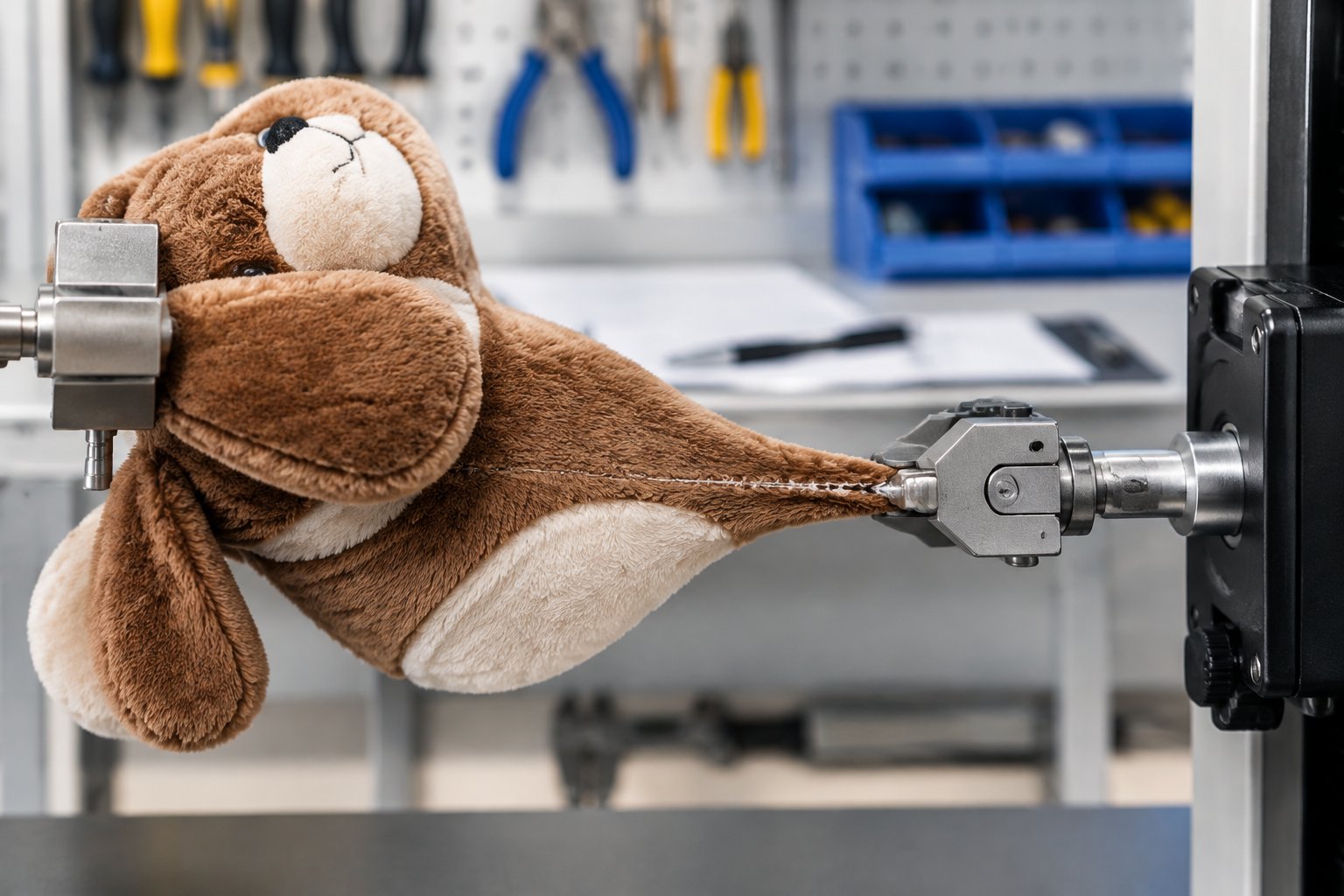
Children's stuffed toys are seam-tested for the same reason dogs open them: a small, determined mouth pulls on fabric. The EN 71-1 procedure — and its ASTM F963-style equivalent — clamps the fabric on both sides of a seam and applies about 70 N (15 lbf), requiring the seam to hold without opening far enough to expose the filling.
On the legal position: those standards are written for children's products, and pet toys are not covered by toy regulation. The 70 N figure is not a legal requirement for a dog toy — it is a proven engineering benchmark the industry already understands. That makes it the cleanest number to adapt: keep the method, scale the configuration to the dog, and write the result into the order as your acceptance standard. For medium and large dogs that means heavier core-spun thread, double rows at the torso and bartacks at every lever point.
Matching Seam Specs to Dog Weight
One seam configuration across a range is a pricing decision, not an engineering one. The tiering below reflects common factory practice for pet plush; treat it as a starting grid for negotiation, not a fixed rule:
| Dog weight band | Stitch density | Thread | Seam construction | Opening closure |
|---|---|---|---|---|
| Under 5 kg | 8–9 per 3 cm | Spun polyester, standard ticket | Single row, standard allowance | Machine or hand closure acceptable |
| 5–15 kg | 9–10 per 3 cm | Core-spun polyester | Single row, bartack at limb roots | Machine closure with bartack |
| 15–30 kg | 10–11 per 3 cm | Core-spun polyester, heavier ticket | Double row at torso and limbs | Machine closure, double bartack |
| 30 kg and up | 10–11 per 3 cm | Heavy core-spun polyester | Double row plus bound or interlined edges | Fully machine-closed; no hand openings |
Two cautions. First, heavier configuration costs real money in thread, machine time and rework — a 15–30 kg spec on a cat toy is waste. Second, the binding constraint is often the fabric: a low-GSM velour tears beside an over-engineered seam, so check fabric weight and seam spec together.
Verifying the Spec: Sample, Line, Shipment
A seam spec earns its keep only if it is checked at three moments. At the golden sample stage, cut one unit open and photograph stitch density, thread, allowance and closure against the specification — this sealed reference defines "correct" for every later dispute. At first article, when the line starts the run, repeat the teardown on the first pieces off it, because setups drift between sample approval and mass production.
During the run, add a spot pull to the line: a gloved hand or spring scale on the closing seam and one anchor point per hour costs minutes and catches a broken thread cone or a skipped bartack long before final inspection. At final inspection, "open seam" and "loose anchor point" must be named defects in the AQL catalog — Critical 0 / Major 2.5 / Minor 4.0 is the consumer-products norm — and the batch's retained samples (three pieces, kept 24 months) should include one cut-open unit when the seam construction is new.
Sources that publish stitching and testing criteria openly are rare, which is why our quality page lists the standards we inspect against. For the failure modes next to seams — stuffing, squeaker pockets and closures — the plush defect field guide and the squeaker pull test cover the adjacent risks.
Frequently Asked Questions
What seam strength should I demand for a plush dog toy?
Does stitch density matter more than thread choice?
Are machine-closed openings really necessary?
Is seam testing legally required for pet toys?
Sourcing plush toys and want seams that survive the first week?
Send your dog-weight bands and target price — we reply with seam configurations, FOB ranges by spec level and the batch test plan we apply.