Key Takeaways
- Freight bills use chargeable weight — the greater of actual and volumetric weight — and plush toys almost always lose that comparison.
- The divisor rules differ by channel: express couriers commonly divide cubic centimeters by 5,000, IATA air by 6,000; sea moves in cubic meters.
- Compression packing can cut billed volume dramatically — and ruin pile and shape if pushed past tested limits.
- Packaging geometry is a design decision: carton dimensions decide how much air you ship, on every channel at once.
- Model head-haul and last mile together — a saving at one leg can double the cost at the other.
The single most misunderstood line on a plush toy invoice is the weight. Buyers budget by what the bathroom scale says, then meet chargeable weight — the number the carrier actually bills, computed from the space the carton occupies. For a category whose bestsellers are bags of air with faces, the gap between those two numbers is not a rounding error; it is a product-design input.
This article walks the arithmetic, the rules per channel, and the two levers that shrink billed volume: compression and geometry.
Chargeable Weight, in One Paragraph
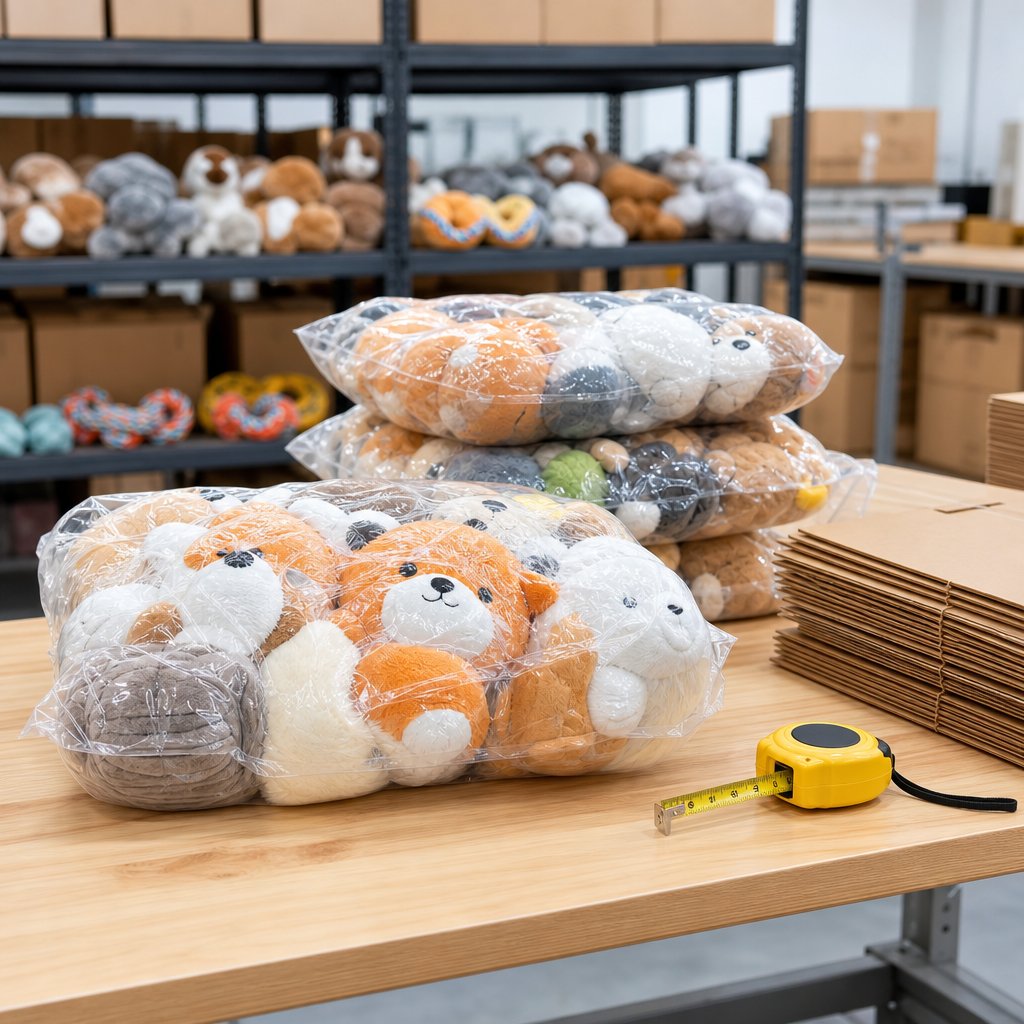
Volumetric weight converts space into kilograms. Measure the carton in centimeters, multiply length by width by height, and divide by the channel's divisor. A standard export carton of 60 by 40 by 40 centimeters holds 96,000 cubic centimeters; divided by 6,000, that is 16 kilograms volumetric. If the carton physically weighs 9 kilograms, the airline bills 16 — the greater of the two, always. The scale measures your goods; the divisor measures your packaging discipline. Buyers who only negotiate the FOB price are optimizing the smaller number. And keep a tape measure in the sample kit from day one, because every dimension question you answer now is a freight line you do not argue later.
The Rules by Channel
| Channel | Basis | Common rule | What it means for plush |
|---|---|---|---|
| Express courier | Volumetric vs actual, greater wins | Cubic cm ÷ 5,000 (practice varies by service) | Small parcels bill roughly 20% above air math |
| Air freight | Volumetric vs actual, greater wins | Cubic cm ÷ 6,000 (IATA) | Compressed bales change the outcome |
| Sea LCL | Cubic meters; weight ratios on dense cargo | Per CBM, minimum charges apply | Cube, not weight, is the budget |
| Sea FCL | Container cube | Pay the box, fill the box | Carton geometry decides value per box |
Three consequences follow. Express is the least forgiving channel for plush — the small divisor and the premium rate compound. Air rewards compression directly: every point of cube reduction is a point off the bill. And sea, the plush workhorse, prices pure volume, which makes it the one channel where packaging decisions are visible to the naked eye at the quay.
A practical habit follows from the table: ask every forwarder to state, line by line, which basis produced the quote — actual weight, volumetric at which divisor, or cubic meters at which minimum. Quotes that hide the basis hide the negotiation. And when two forwarders quote the same load a third apart, it is usually not the market; it is an assumption about compression, carton size or minimum charges that one of them made quietly.
Compression: The Save and the Risk
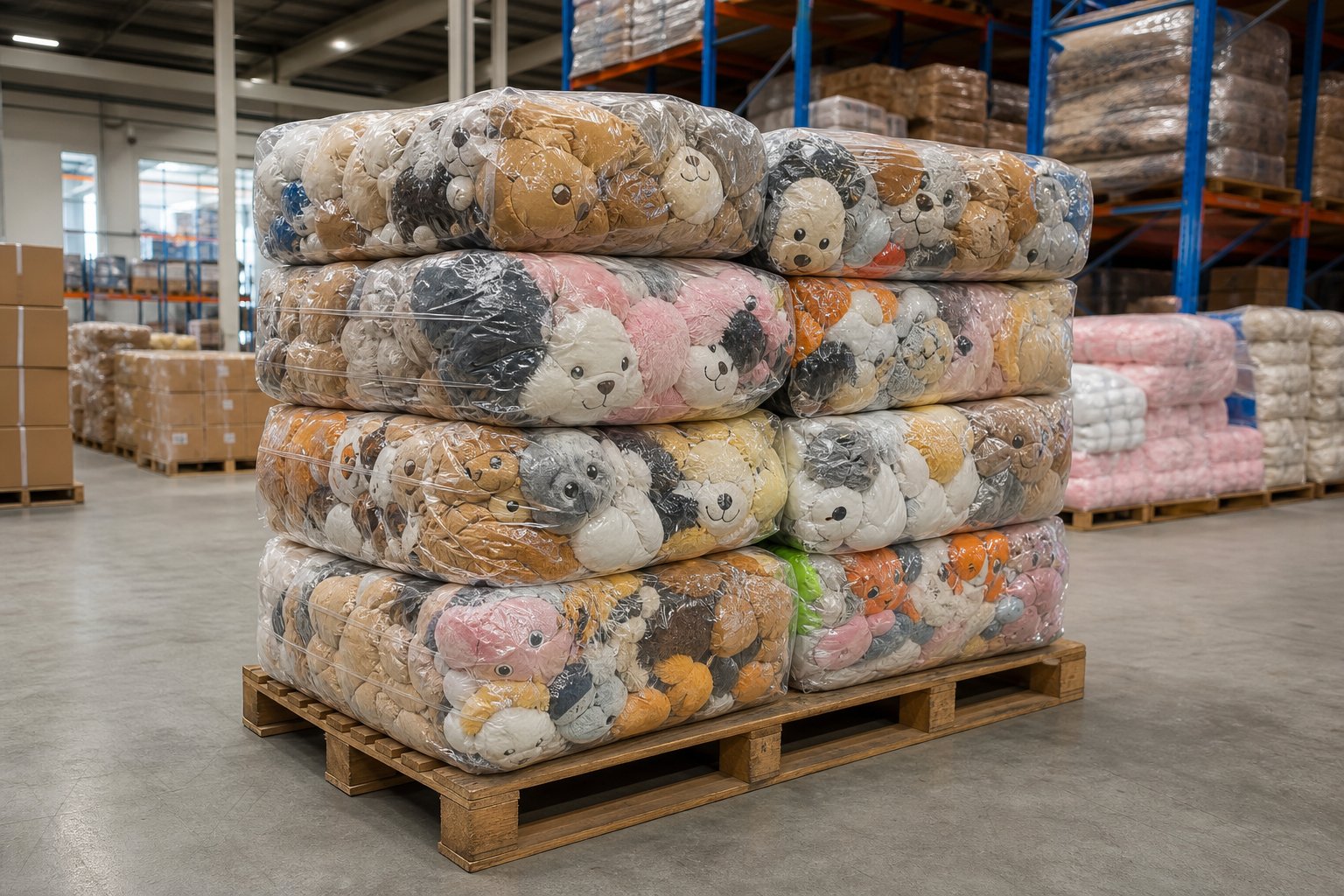
Because plush is recoverable, it can ship squeezed. Compressed bales — vacuum-sealed or simply over-strapped — routinely cut billed volume by a third to a half on plush-heavy loads. On a 4.8-cubic-meter LCL shipment of 1,000 stuffed toys, a 40 percent cube reduction turns into roughly 2.9 cubic meters billed: the same goods, the same FOB, a smaller number on the freight line.
The risk is that plush remembers. High-pile fabrics and densely stuffed shapes recover slowly; seams set under pressure; creases survive the shelf. Recovery is a fabric property, not a promise, and it varies batch to batch. The professional protocol: compress a production sample for two to four weeks, unpack it, and judge pile, shape and seams against the golden sample before booking any compressed load. Approve the bale the way you approve the toy.
Packaging Geometry Is a Design Decision
Every centimeter of carton is a subscription: it bills on the head-haul, again on any air leg, and again at the last mile where marketplaces and couriers run their own dimensional rules. That makes inner-carton dimensions a design parameter, on par with fabric and fill. The levers, in order of impact:
- Right-size the export carton. Air pockets bill like toys. Cartons should match the product's nesting dimensions, not the factory's stock box.
- Design shapes that nest. Flat-based toys and stackable forms cube better than spheres — worth knowing before the mold is cut, not after.
- Check the retail package against the shipping carton. A window box that wastes twenty percent of the carton wastes twenty percent of every freight bill, everywhere.
- Model the last mile separately. Parcel carriers apply their own dimensional divisors; a carton that is efficient on water can be expensive on a doorstep.
The broader trade-offs — material swaps and structure simplification that also protect shelf appeal — are laid out in our piece on cutting ship weight without cutting perceived value.
A Worked Head-Haul and Last-Mile Example
Put the pieces together for a typical program: 1,000 plush toys, 20 per carton, 50 cartons of 60 by 40 by 40 centimeters — 4.8 cubic meters loose, about 2.9 compressed. As sea LCL the load bills on cube; as air freight it bills 16 kilograms a carton unless compressed bales pull the volumetric down. At the last mile, the same toys ship as individual parcels, where each courier's dimensional rule prices the retail box, not the export carton. The pattern that falls out: compression pays at the head-haul, geometry pays at the last mile, and the cheapest program passes both tests. Neither number is negotiable directly — you negotiate the inputs: the divisor assumption, the carton, the bale, the retail box. The invoice merely sums the decisions.

Channel selection sits one level above this arithmetic: when each mode earns its keep, see sea, air or express. And for how these packaging decisions interact with private label artwork and warning labels, our fulfillment team keeps the standards on the dropship program page.
Frequently Asked Questions
How do I calculate volumetric weight for a plush toy shipment?
Why do express, air and sea use different rules?
Is vacuum compression safe for plush toys?
What cuts volumetric cost fastest?
Shipping air at toy prices?
Send your carton dimensions and destination mix — we will show where compression, geometry and channel choice cut the billed volume.