Key Takeaways
- China's pet toy supply is not one city: plush concentrates in Yangzhou, plastic and TPR capacity in Chenghai, rope and leather-heritage goods in Pingyang, and consolidation in Yiwu.
- Each belt has a distinct MOQ and lead-time character: sampling speed in the plush belt, tooling logic in the plastic belt, labor-scaled braiding in the rope belt.
- The headline statistics are industry-wide calibers — Yangzhou's RMB 30 billion is all plush, Chenghai's is all toys — not pet-toy figures.
- Capacity is spreading: Lianyungang's 2026–2028 plan targets a RMB 7 billion pet economy, and single-factory exporters in central China ship millions of units a year.
- Use the map to shortlist, then audit: the city tells you where a process lives; the audit tells you which factory deserves the order.
Ask a room of pet toy buyers which Chinese city they should fly to, and you will hear four answers and an argument. The plush loyalists say Yangzhou, the hard-goods buyers say Chenghai, the chew-and-rope crowd says Wenzhou, and someone mutters that the real answer is the Yiwu market because everything is on a shelf there. All four are partially right, which is exactly the problem: a category this process-diverse does not concentrate in one postal code.
This article is the map we wish someone had handed us earlier — who makes what, where each belt's verified numbers actually come from, how lead-time character differs by city, and a decision walk for choosing between a belt and a factory.
One Country, Four Belts and a Rising Second Tier
The structure of supply follows process. Plush toy competence follows Yangzhou, in Jiangsu province, which official media have called the country's plush toy gift capital since 2006 and re-confirmed in 2020; provincial reporting in January 2026 put the city's plush industry above RMB 30 billion in annual output, over 30% of the national market and close to a fifth of global production — a full-industry figure that pet plush extends from, not a pet-toy statistic. Injection-molded and vinyl competence follows Chenghai in Shantou, Guangdong, where per China News Service reporting in 2026 some 60,000 toy firms produce roughly a third of the world's plastic toys.
The third belt is Wenzhou's Pingyang county, designated in 2014 as the country's only "China Pet Supplies Export Base": Xinhua-reported figures describe nearly 100 pet supply firms generating over RMB 5 billion in 2024, dog-chew exports above half the national total — customs data put the share above 60% — and a third of China's pet leashes. Fourth comes Yiwu — not a manufacturing belt but the trading hub, its pet ecosystem commonly cited at 10,000+ related businesses and annual exports above RMB 3 billion. Around these four, a second tier is forming, most visibly Lianyungang, whose city government has published a 2026–2028 action plan targeting a pet economy above RMB 7 billion.
The Map, Belt by Belt
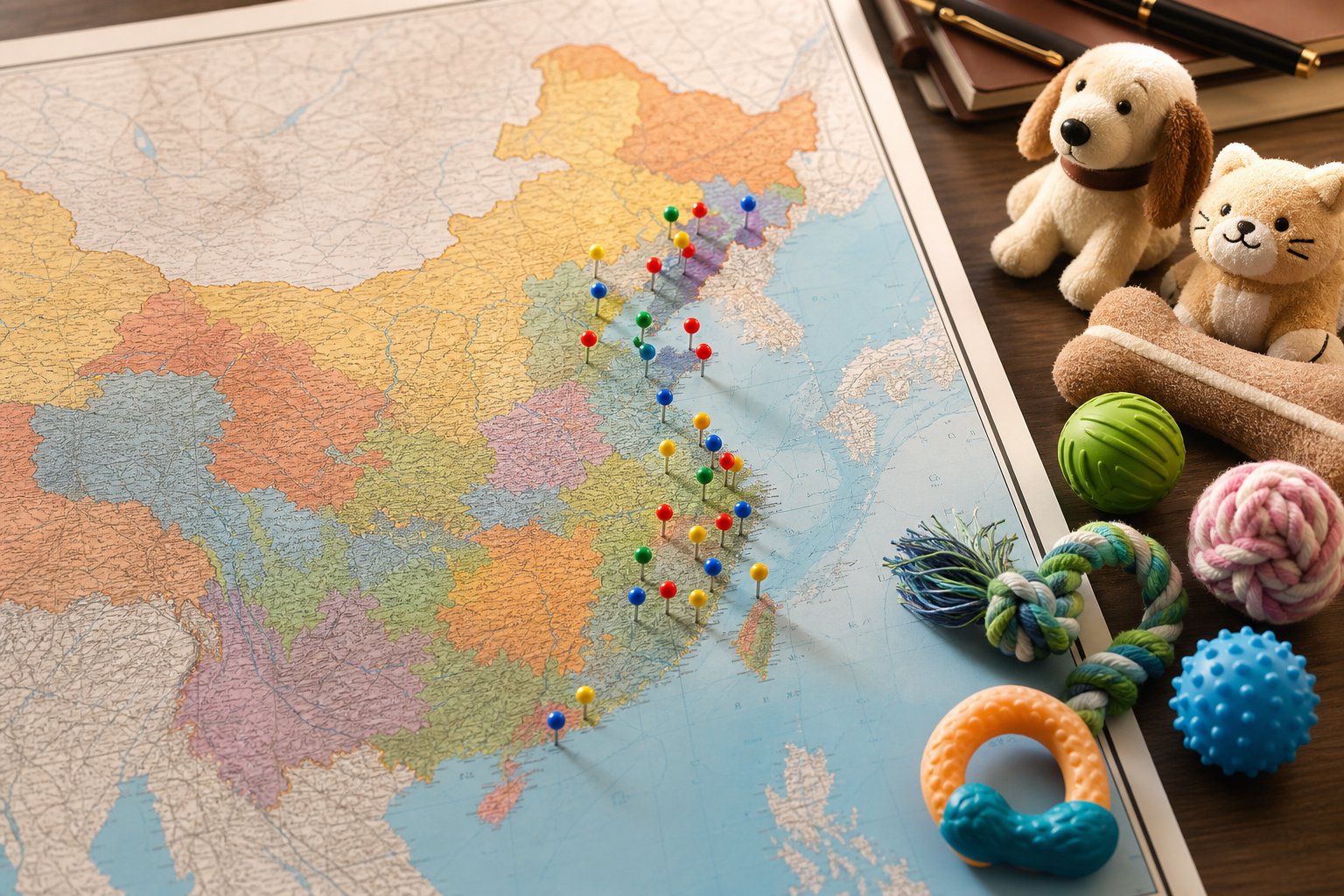
Condensed to its load-bearing rows, the map looks like this:
| Belt | Signature category | Verified anchor facts | Best fit for |
|---|---|---|---|
| Yangzhou (Jiangsu) | Plush and squeaky plush; pet lines extend the gift-plush base | Plush industry above RMB 30 billion (2025, provincial media); title held since 2006, renewed 2020 | Plush ranges, private label, fast sampling, seasonal characters |
| Pingyang (Wenzhou, Zhejiang) | Chews, rope toys, leashes, leather-heritage goods | "China Pet Supplies Export Base" since 2014 (only one nationwide); chews over half of national exports; leashes a third of domestic output | Rope and tug lines, chew-adjacent items, leash-toy bundles |
| Chenghai (Shantou, Guangdong) | Injection-molded plastic, TPR, vinyl; tooling ecosystem | About 60,000 toy firms; roughly a third of global plastic toys (2026, China News Service) | Hard plastic and TPR toys, balls, treat dispensers, custom molds |
| Yiwu (Zhejiang) | Consolidation and trading; latex squeaky toys ship from here | 10,000+ related businesses; annual exports above RMB 3 billion; a dedicated pet zone of 8,000 sqm with 30,000+ items | Mixed containers, stock programs, small-lot breadth, dropship prep |
| Lianyungang (Jiangsu) | Emerging plush and full-line pet supplies | City plan targets RMB 7 billion pet economy by 2028; Ganyu district hosts close to 100 toy firms | Second-source capacity, growth partnerships with newer plants |
Two footnotes complete the picture. Sui County in Hubei has a pure-export pet toy factory reporting 15 million units and over USD 30 million a year — a single-company data point, never a county-wide cluster. And the raw-material map stretches offshore: Thailand supplies more than half of China's natural rubber imports, which is why latex toy pricing moves with Southeast Asian feedstock.
Lead-Time and MOQ Character by Belt
Scale figures say where capacity lives, not how a belt behaves on your calendar:
- Yangzhou plush. Sampling runs in days because fabric, fill and embroidery are local; revised samples on existing patterns take our program 7–12 days. Production windows compress hard before Q4.
- Chenghai plastic. Everything is a tooling decision first: the industry norm for a new mold runs 25–60 days, while public-mold catalog items can ship almost immediately. Customization is slow once, fast forever after.
- Pingyang rope and leather heritage. Braiding and cut-and-sew scale with labor, so surge capacity is real; years of chew-for-export discipline leave a compliance-minded vendor base.
- Yiwu hub. Stock ships in days — our in-stock private label program dispatches in 5–10 days including relabeling — and breadth across 30,000+ market items beats any single factory's catalog.
- Second-tier cities. Hungry capacity and competitive quotations, but thinner track records; treat them as pilot grounds before anchoring a program.
Choosing Belt or Factory: A Decision Walk
A map only helps if it ends in an order. The walk we recommend:
- Step 1 — split the SKU list by process family. Plush, hard plastic, TPR, rope, latex: five families, five likely addresses.
- Step 2 — pin each family to its belt. Use the table above; resist the temptation to force every item into one city's vendor list.
- Step 3 — mark anchor versus flex SKUs. Stable volume items justify a named production line; tests and seasonal items belong to whatever belt quotes them fastest.
- Step 4 — choose the consolidation point. If the assortment spans belts, a Yiwu-style hub turns multi-vendor output into one container and one document set.
- Step 5 — audit the line, not the city. The map produced the shortlist; the audit, samples and AQL terms decide who gets the purchase order.
Reading the Map as One Supply Chain
The belts are complements, not competitors. A plush body sewn in Yangzhou can carry a TPR chew part molded in Chenghai's ecosystem and ship inside a container consolidated in Yiwu; a rope toy braided in Pingyang belongs in the same assortment as a latex squeaky toy bought through the Yiwu rows. Buyers who treat the map as one supply chain — instead of a beauty contest between cities — consistently get shorter calendars and cleaner quotations.
That is also a fair description of how we run TOYORIGIN: production anchored in Yangzhou's plush belt across eight cooperating lines with monthly capacity above 1.5 million units, plastic and TPR programs drawing on the wider belt network, and fulfillment consolidated in Yiwu for both bulk containers and single-parcel dropshipping. Deeper dives into each stop are in our guides to Yangzhou, Pingyang, Chenghai and Yiwu, and our factory page shows how the two bases split the work.
Frequently Asked Questions
Which Chinese city should a pet toy buyer visit first?
Are the famous belt statistics actually about pet toys?
Can one supplier cover every pet toy category?
How do emerging supply cities change the picture?
Want your own SKU list pinned to this map?
Send the categories and target quantities — we will return a belt-by-belt routing with FOB ranges and a realistic calendar for each stop.